



Another Kind of Camino
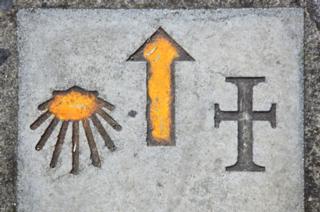
During the past few years, I have heard many people describe their Camino journeys that took several weeks through difficult terrain. Listening to their stories and reading their accounts have made their Camino narratives exciting. Then there came the movie “The Way” which further enlightened one, in a Hollywood manner, about what happens to a person traveling to Santiago de Compostela in Spain. Reading Joyce Rupp’s “Walk in a Relaxed Manner” also emphasized how one can change and grow in a very real way. It is Bunyan’s “Pilgrim’s Progress” all over again, or the child’s version of Enid Blyton’s “The Land of Far Beyond.”
I would love to walk even a small part of the Camino, but wonder if I am capable of doing it. As I mused about all this, I couldn’t help but think of Mary and Joseph trudging through hazardous territory to reach Bethlehem many, many years ago. Having traveled through that area, I am keenly aware of how difficult it must have been back then. After all, they had no GPS to lead them to their destination! There is only the evangelist Luke’s account that Joseph took his wife Mary, who was with child, on a long trek from the town of Nazareth in Galilee to Bethlehem in Judea. In a couple of sentences, the Gospel tells in a matter–of–fact manner their travel story.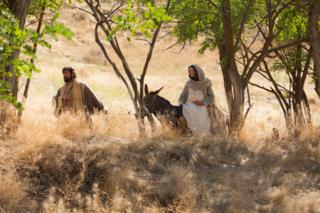
Over the passage of time, various artists have depicted the scene of a tired Joseph patiently walking beside a pregnant Mary seated sideways on a donkey. It was an early Advent of waiting for the child to be born. To enter into that time and space, is to walk another “Camino,” the destination being Bethlehem. There were no “albergues” (shelters) or inns as we know them, but places where people and animals slept together. The “peregrines” (pilgrims) were forced to travel in groups to avoid robbers.
Mary was probably walking “in a relaxed manner” given the late stage of pregnancy. Their mandated adventure probably took them over the mountains through Cana to the Sea of Galilee, the Jordan valley south to Jericho, the barren wilderness of the Judean desert, and onward to Bethlehem.
Were Joseph and Mary greeted with warm hospitality as are the pilgrims on the Camino? The sights, sounds, and smells of their dusty walk was a far cry from what modern day pilgrims face while crossing the Pyrenees… They had no pilgrim passports or “credenciales” to show, and had to persevere without complaints.
 The distance Mary and Joseph had to travel was about 70 miles, which could have taken them four to seven days given the obstacles they encountered. The Camino pilgrim takes 5 weeks or more to walk approximately 1000 kms. The challenge of each new day brings a freshness that lifts the fatigue of trekking endless miles into the unknown.
We are invited to walk the Camino of life welcoming the ups and downs as they arrive. Letting go of the excess baggage we carry gives us a freedom to experience something new. Disappointments on the journey are stepping stones to different paths, and “struggles are the fertilizer for spiritual growth” as Joyce Rupp says.
Perhaps Mary asked Joseph, “Are we there yet?” In the words of a Christmas Carol we sing, “How far is it to Bethlehem? Not very far. Shall we find a stable room lit by a star?”

No Comments