



Pentecost 2016: The Gift of Piety
During a sabbatical a few years ago, I made a pilgrimage along the 800 km route of the Camino de Santiago de Compostela in northern Spain, to the traditional tomb of St. James. It is easy to get lost if you stop paying attention and go off the route because you missed one of the yellow arrows painted on the road, a building, a tree, or, even, a bale of hay. After I lost my way a few times, I got into the habit of blessing myself with the Sign of the Cross each time I saw a yellow arrow.
In the years since then, I bless myself whenever something that I was worried about works out. For instance, if I misplace my wallet, I bless myself when I find it. That act of mine is an act of piety. It serves as a reminder for me to thank God for his presence and protection in my life. Older generations used to bless themselves whenever they drove or walked past a church. Some Christians bow their head each time they hear the same of Jesus in a scripture reading, homily or prayer. These are all acts of piety.
Piety is one of the seven traditional gifts of the Holy Spirit. Previous Pentecost posts have looked at courage, wisdom and knowledge. With the gift of piety, sometimes called reverence, we have a deep sense of respect for God and the Church. A person with reverence recognizes our total reliance on God and comes before God with humility, trust and love.
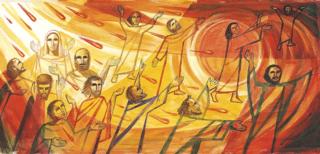 Piety is the gift whereby, at the Holy Spirit’s instigation, we pay worship and duty to God as our Father. It orients us toward God, and, in turn, toward our brothers and sisters as children of God. It encompasses worship of God, in moments of prayer as well as in lives dedicated to love of God and neighbour. The gift of piety perfects the virtue of justice, making it possible for us to fulfill our obligations to God and neighbour. We are not only motivated by the requirements of justice but also by the loving relationship we share with our neighbour.
Thus, we fulfill the commandments, not just because they are commandments, but because obedience is a way of loving and serving the Lord. Our worship of God is an act of love. Pious acts are a sign of our natural, instinctive affection for God. They come naturally, in much the same way that we spontaneously respect our parents.
In a short teaching before the Angelus some years ago, Saint John Paul II explained that with the gift of piety “the Spirit heals our hearts of every form of hardness, and opens them to tenderness towards God and our brothers and sisters.” The hardness of hearts cannot exist when we are reminding ourselves of God’s presence. The gift of piety removes from our hearts any tensions, division, bitterness, anger and impatience. These are replaced by feelings of understanding, tolerance and pardon.
The Pope went on to connect piety with the Sacred Heart: “With the gift of piety the Spirit infuses into the believer a new capacity for love of others, making our hearts participate in some manner in the very meekness of the Heart of Christ.”
Pious acts serve as daily reminders of God’s role in our lives. Why not give some thought this month to what acts of piety you practice. Is there something else you can do to help you to worship God on a daily basis?
No Comments