



Holy Thursday and Humility
This evening's Mass of the Lord's Supper includes the beautiful ritual of the washing of feet. Pope Francis surprised all of us and angered many when he washed the feet of people in a juvenile detention centre on his first Holy Thursday as Pope. Not all twelve were male. Nor were they all Christians. It's traditional that those whose feet are washed are all males because the twelve apostles were all male. However, as long as I can remember, there have been parishes and settings such as retreat centres where the presider has included women in the ritual.
On the other hand, I can recall seeing situations where the chosen twelve are not just all males; they have also been among the most influential parishioners. I have no evidence, but I suspect that there were situations where they were probably among the most generous with their financial contributions to the parish. It always struck me as odd that the ritual, a strong statement about service, should be turned into a kind of reward for exclusively male leaders in the community. Thus, I welcomed the decision by Pope Francis to change the policy in the universal Church regarding who can participate in the washing of feet at the Holy Thursday liturgy.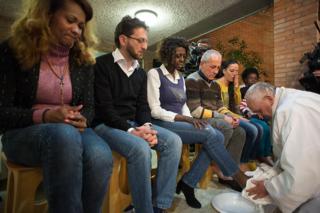
Pope Francis actually made his decision to revise the rules for the foot-washing ritual in a letter signed on 20 December 2014, but the letter was only published on 21 January 2016. He said that the rite should no longer be limited to men and boys, but also include women and young girls. Francis wrote that the change is an attempt to "express the full meaning of the gesture performed by Jesus at the Last Supper, his gift of himself to the end for the salvation of the world, his boundless charity."
The Pope stresses that it was only after careful consideration that he decided to make a change in the Roman Missal. The actual change in wording says, "Pastors may choose a group of faithful representing the variety and unity of every part of the People of God. This group may consist of men and women, and ideally of the young and old, healthy and sick, clerics, consecrated persons and laypeople."
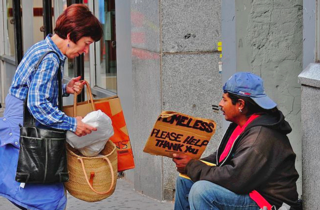 This change is another example of Francis shifting the focus from who can participate, to the power of what we are actually commemorating. Here, of course, it is boundless charity and service. "If I, your Lord and Teacher, have washed your feet, you also ought to wash one another's feet. For I have set you an example, that you also should do as I have done to you.”
There is no need this evening to focus on which twelve members of the community have their feet washed by the pastor. Rather, this evening's celebration is a suitable time for all of us to reflect on the humility of Jesus and what his example means for each of us in our ways of being leaders. Christ came not to be served, but to serve. The washing of the feet is just one example of a humble action.
Each of us has to find our own path. Is it washing up after a sick person has made a mess?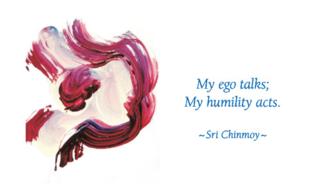 Is it not defending ourselves when someone has uttered lies about us? Perhaps it's in our decision to refrain from boasting about ourselves when we've achieved something special. It may be a choice to wash the toilets even though it's not our responsibility. Humility is not confined to just one action. Jesus showed us that it's a way of life. Let's take time at this evening's Mass of the Lord's Supper to consider the humility of Jesus and the example he is setting us.
No Comments