



The JVC Advent Spirit

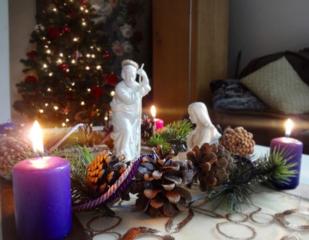
The spirit of Advent is upon us in the JVC household, and I am contemplating what Christmas will mean for me as a JV. This is my first Christmas away from my family, and I am separated from many of my usual points of reference—things that normally make Christmas feel like Christmas. We are doing our best to create some of our own Christmas traditions. We have a homemade advent wreath and a small Christmas tree. It makes our household feel homey, but it doesn’t feel familiar in the way this season usually does for me. My separation from my old life and my family feels more obvious than ever.
The absence of the usual hallmarks of the holiday season is disorienting, and even calls my identity into question. I did not realize how much I identified myself by these things, and how much I believed they were essential to who I am. Earlier this month, Louise, Josh, and I visited the Toronto Christmas Market, and though the lights and Christmas cheer were exciting, I felt different in the midst of the hustle and bustle. The trimmed trees and twinkling lights warmed my soul, but because of my new lifestyle in JVC, I felt an invisible barrier between myself and the rest of the carefree shoppers. I felt rather bare next to the Christmas pomp and circumstance. Our JVC budget allowed us to look but not to buy anything, and I was left wondering what my place is in the season.
My placement, too, is making me feel bare. It seems like everyone’s need is much greater at Christmas. A community drop-in centre like St. John’s Mission can help, but it cannot fill all the hungry bellies, and I feel helpless when I have to send away people looking for groceries or a Christmas turkey.
Over and over, Advent is forcing me to confront the absolute poverty of my situation. Not only am I materially poor, but my placement forces me to repeatedly encounter my own inadequacies. I cannot quench the need Christmas creates for the poor and marginalized, because the need is just too great.
 So, over and over, I find myself asking the questions “who am I?” and “Where do I fit in all this?” Without my regular points of reference—family, friends, and support from home—it’s quite easy to feel like I am nothing, and wholly insignificant.
Nevertheless, the Advent season reminds me that the limitations I’m coming to face are actually more essential to who I am than any of the things I am missing. A few weeks ago, we spent one of our community nights at a panel discussion on Syria at Josh’s volunteer placement, Canadian Jesuits International. The panel discussed the humanitarian response to the vast amount of refugees coming from Syria. After the panel, I reflected upon what the refugees must be going through. I wondered whether being forced to leave their homes and families ignited in them the same questions about identity I have recently been experiencing. In the stories I’ve heard about Syrian refugees, I am struck by how they seem to retain a sense of hope with which to rebuild their lives, though they have lost things I have thought are essential to a person’s being. I marvel at their ability to keep going, when my own struggles, small by comparison, have left me without knowing where to turn.
In this season, I have found myself turning where Advent calls me to turn: to the Incarnation of Jesus.  By becoming human, God joined the vulnerability inherent to humanity, showing us the ultimate act of solidarity. As I reflected on the Incarnation this month, I realized that the poverty-stricken way Jesus entered the world—the way he accepted the limitations of being human—suggests that embracing my own limitations is an essential part of becoming human. This has taught me about my poverty in relationship to God: the recognition of my own limitations, or poverty, draws me closer to God because I realize how much I need God. My JVC experience of being without the things I am used to having, and feeling helpless at my placement is becoming an experience of who I truly am in light of God.

No Comments