



2nd Sunday of Advent – The Uncomfortable Truth
 We are reminded today that Isaiah prophesied a voice crying out in the wilderness: "Prepare the way of the Lord, make straight his paths. Every valley shall be filled and every mountain and hill shall be made low." That voice belongs to John the Baptist, the son of Zechariah, himself a holy man. John's was a powerful voice. He was an itinerant preacher who had a major influence on Jesus' way of proceeding. As we know, he saw his role as being the precursor of Jesus. "He must increase and I must decrease."
John's way of communicating had nothing to do with ego. He, like Isaiah and other Old Testament prophets, was passionate about justice, challenging the status quo, and rooting out the unfaithfulness of the women and men of his day. More than ever, we need prophetic figures who give us hope.
Our world is crying out! I'm writing this on the day after the Gospel portrayed Jesus weeping over Jerusalem. Jesus has many reasons to weep these days: relentless acts of terrorism, Syria, increasing fear and hatred of outsiders, Lebanon, political figures who play into our fears, Paris, Afghanistan, a mosque being burned in Peterborough, ON, Muslim women being attacked in our cities, and so on. Jesus weeps and he invites us to weep as well, but also to act.
Guess what! The fact is that we have prophetic figures. When we think of a broad notion of prophecy, we can include many who speak the uncomfortable truth as opposed to the expedient lie (that distinction comes from Vaclav Havel, the first President of the Czech Republic). There are many religious, secular and political leaders, and ordinary men and women who speak with passion and hope about issues in our world. Their words are a challenge to our lifestyle and our complacency about the possibility of change.
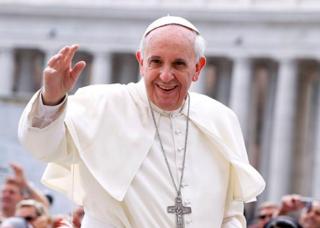
An obvious illustration is Pope Francis. Laudato Si is a strong prophetic document. It is sweeping in its confrontation with our human treatment of the globe and with one another. Prophetic words are usually met with strong resistance from the people who have the most to lose when the status quo is threatened. Laudato Si is a threatening document for many people. There are people who would like to put it on a shelf and collect dust.
Would we be to able to hear John today? Are we able to hear the prophetic characters in our culture and era? Some might be able to hear, but unfortunately they are not usually in positions of power. The voices of challenge and sanity are so often drowned out by conflicting voices. Those voices are often politicians who are more motivated by re-election than by doing the right thing. Those voices can be from people who have a vested (read financial) interest in maintaining the status quo. Those voices can be from racist and bigoted individuals.
 Are we able to open our ears and hearts, to really and truly hear the cries of people such as John the Baptist? He shows us a few of the characteristics of many of our prophetic people. He spoke the truth in a spirit of humility. He offended many who listened to him. People can get uncomfortable with prophetic figures who are too honest and blunt. John was a threat. A prophet is in tune with God's movement in his or her life. They listen in an astute and discerning manner to how the Word of God intersects with human reality.
Our Advent journey continues. Here's a simple idea for part of our prayer this week. Think of someone such as a spiritual author, a religious leader or an inspiring individual whose words pose a threat to your complacency. What does that do to you? How do you pray with that? Let's bring that with us on our Advent adventure.
No Comments