



Keyword: Jesuit, Genre: Autobiography – What Being a Jesuit Means to Me…. Jean-Marc Laporte, SJ

 In May 2014, igNation launched a series exploring the Jesuit identity as it is expressed in works of fiction: "Keyword: Jesuit, Genre: Fiction". This was followed by the series "Keyword: Jesuit, Genre: Biography". In these two series we hear what others think about what it means to be a Jesuit – in fiction and in biography.
This new series – “Keyword: Jesuit, Genre: Autobiography” – will explore what it means to be a Jesuit today – as told in their own words by Canadian Jesuits. The articles – written for igNation –are as different in expression and format as the men who wrote them.
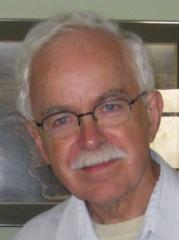
Today's posting is by Jean-Marc Laporte SJ
Recently, on the occasion of a ceremony marking the 50th anniversary of Regis College, I was asked to offer reflections from my own experience to the graduating class of Regis College. As I review what I said then, it is clear to me that the story I told is closely bound up with my life-long commitment as a Jesuit.
What have the events of my career as a Jesuit and as a priest taught me? Let me start off with a remark some have heard me make when reflecting on the meanderings of my own life: “Had I had false teeth, I would have swallowed them on the spot.”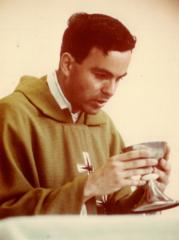
When I graduated as a young Jesuit priest with my degrees in theology, my life plan was simple. I was going to teach theology for the rest of my life and do some writing, like my favourite teachers such as Fr. Fred Crowe. Superiors were sympathetic to this use of my talents. But my life did not go according to plan.
The first big surprise was being summoned in 1975 by the then provincial superior who asked me to become president of Regis College at a contentious time just before its move downtown from our campus close to the northern border of Metro Toronto. This was my first false-teeth experience. I had neither skill set nor desire nor the temperament for this kind of work, but I was young and foolish, and a Jesuit vowed to obedience I said yes without demur and slowly learned some of the technical, relational, and leadership skills I needed for this new assignment.
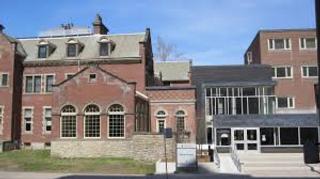 That whole period of my life – marked by both teaching and administration – came to an end when I retired from the Toronto School of Theology directorship in 1999. I had visions of being able to resume full-time academic life according to my original plan, mainly with teaching but also with research and publications. But this set me up for a second false teeth experience. The provincial of the day asked me to become his socius (a cross between executive assistant and companion), which meant yet another shift, this time away from Regis College, and once again with new skills and a new mind-set to learn. The learning curve was not so steep, and I soon took my turn being provincial superior.
When my mandate as provincial came to an end, a third false teeth experience: Finally, I then thought, I can get back to my original plan, to the leisurely academic activity of a semi-retired professor, and pick up the threads of my tattered scholarly existence. But I was asked to move to Halifax to take over a spirituality centre and work in pastoral and spiritual ministry, following in the footsteps of my esteemed predecessor, Fr. George Leach. This is my current occupation.
Right now in addition to running the small spirituality centre in Halifax, I animate retreats and do spiritual direction. For the last three years I have been priest-in-charge of the neighbouring parish of St. Patrick’s (the title the Archbishop allowed me to assume rather than the more canonically correct “administrator.”) George wanted to situate the new Halifax centre in a poorer neighbourhood, and finally in my Jesuit life I am having plenty of contact with poorer people, many of them homeless and rejected by our society. During this time I have also finished a manuscript on the Trinity, a project which had been interrupted many times by the vagaries of holy obedience. Life in this new setting has been good, though more fragile as I get older.
Jesuits live in a world of dizzying change. We are fewer, and the needs are more urgent. One hundred years ago, there would have been no need to disturb the original life-plan which I and my superiors had approved. People with other skills and temperaments and desires would have been at hand to do what I ended up being asked to do and would have done a much better job of it. But given declining human resources my superiors had to make hard choices. As a wise man once told me, you must break eggs to make omelets.
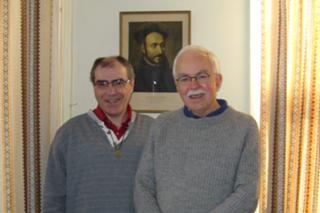 At the same time, I can truly say upon looking back that the Gospel has it right: my yoke has been easy, my burden light. Sudden changes of the direction of one’s life are disruptive, but in the Jesuit way of obedience I was invited to enter into the dance of ceaseless change which marks our time. I had to let go of my expectations, pull up roots, and learn new skills, above all flexibility, open myself to new graces, above all availability, to be thrust into the midst of a world which is messy, ambiguous, full of surprises. Such letting go releases new energy and new life.
The Lord’s plan for me has been broader and richer than anything I could have dreamt of in my younger years. There has been some struggle and plenty of anxiety, but in the end a sense of comfort, of deep continuity with what I have always wanted to be. Fortunately I managed to maintain teaching as a key part of my life for some thirty years. My formation in theology, including my doctoral studies, remains a vital part of who I am and has offered a welcome theological perspective for myself, and hopefully for those I serve today in the my current ministries.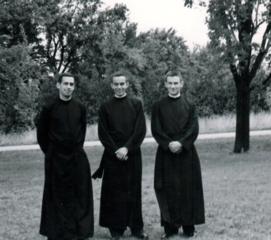
Often enough, we form too clear an idea of our own gifts and preferences, our vision is too rigid, and this leads to a self-enclosed development in which we unwittingly protect ourselves from the very realities of the world we are to serve constructively and compassionately. We have some knowledge of our own potential, but who better knows us than the One who knit us from our mother’s womb and who knows our inmost thoughts. It is always better to graciously yield to the promptings of a Provident God who knows how best to bring authentic fulfilment to our lives and our ministries, how best to attune us to the work of the risen Christ who seeks to transform the world, patiently, gently, respectfully, but with the invincible power of the Spirit.
I do believe that being a Jesuit was the best way for me to be nudged towards openness and availability. I have struggled with my resistance and reluctance, but in the end the grace of God has been abundant for me.
 Willy nilly, we Jesuits are part of the rapid and unfathomable change which marks our world. With some trepidation and anxiety, we are letting go to join the dance. We are very often called to set aside parts of our life plans, but we are finding undreamt of opportunities. In the end the tapestry of our lives is richer and more varied than anything we might have imagined. We are discovering inner resources and strengths we had not suspected were ours. New relationships and networks fill out our lives. And when we look back so often what emerges is the conviction that what we are is what we were meant to be, what we are doing is what we were meant to do. Our struggles are not self-enclosed and self-defined, but are part of the only struggle that really counts, that of Christ labouring to reconcile the world to himself and to bring it to its final stature. To join this struggle is a great grace. It is our response to the call of the eternal King.

Fr Michael Eades
Posted at 15:35h, 26 AprilThank you for this beautiful piece!
Fr Michael Eades
Posted at 15:35h, 26 AprilThank you for this!