



A Lenten Bookshelf: A Six-Fold Path: Week Five – Edith Stein O.C.D.

By the solemn forty days of Lent the Church unites herself each year to the mystery of Jesus in the desert.
(From Article 540 of the Catechism of the Catholic Church)
In this six-part series, Kevin Burns selects a book for each week of Lent. Each book speaks to one of the great traditions within Catholic culture. Each book also shows how its author integrates that tradition. Six different approaches to the same journey through the desert of Lent to the Easter promise of resurrection.
Week Five: Edith Stein O. C. D. (St. Teresa Benedicta of the Cross) on the Carmelite path.
Once upon a time (in the first decade the fourteenth century) St. Albert, the Patriarch of Jerusalem, proposed the creation of a community for those hermits and pilgrims who had chosen to live on Mount Carmel in the Holy Land in those turbulent decades following the violence of the Crusades. He suggested that they formalize a way of life that integrated their spirit of pilgrimage. He proposed that they organize themselves, elect a leader, and then build a chapel. And so they did, and thus what we now know as the Carmelite movement was launched, adhering to what is known as the Rule of St. Albert.
 Fast forward to 1933. A Jewish convert, Edith Stein, has chosen to enter the Carmelite monastery in Köln, Germany. The Carmelite world she enters is not quite the same as that imagined by St. Albert. The particular Carmelite tradition that attracts her is the one influenced by the mystic, poet, and saint, John of the Cross. He, in turn, had been influenced deeply by Saint Teresa of Avila. Together they shaped the Discalced “branch” – literally “shoe-less” – of the Carmelites, committed to an overtly austere and disciplined spirituality.
Saint John of the Cross was born in 1542 and was educated by Jesuits. He joined the original “branch” of the Carmelites in 1563 and was ordained a priest four years later. Uncertain about where his real spiritual “home” might be found, he contemplated joining the Carthusians, but dropped that idea when Theresa of Avila intervened. She invited him to join the “branch” of the Carmelite movement that she had founded, the Discalced Reform Carmelites. And so he did, taking over the leadership of her house of study and eventually becoming the confessor to the Carmelite nuns of Avila from 1572 to 1577. He wrote, “What more do you want, O soul! And what else do you search for outside, when within yourself you possess your riches, delights, satisfactions, fullness and kingdom – your Beloved whom you desire and seek?” 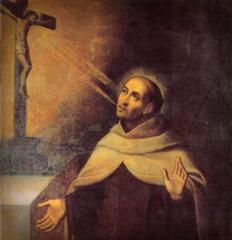
Sometimes that kind of seeking gets interrupted. Things took an odd turn within the Carmelite world when the Calced (as in “shoe-wearing”) and the Discalced (“shoe-less”) didn’t quite see eye-to-eye on some of the basics. This echoed the historic rift in the Franciscan world when the original Friars Minor saw their hood-wearing Capuchin brothers break away, for example. Rather than digress on the many examples of breakaway/reform movements within religious traditions, I want to get back to Edith Stein who was born Jewish (1891), who converted to Catholicism (1922), and who entered the Carmelites (1933) with their tradition of prayer, contemplation, silence, solitude, asceticism. Meanwhile, outside the gates of her welcoming cloister, Hitler had assumed power in Germany.
Edith Stein was an academic and only 25 when she received her doctorate in philosophy. She worked as an assistant to the philosopher and phenomenologist Edmund Husserl. If her conversion to Catholicism had shocked her colleagues, then her decision to enter the enclosed world of the Carmelites confused them altogether. The German philologist, Max Müller, describes a meeting with her in 1931, shortly before she turned away from the academic world altogether. “She appeared to me full of joy, feminine, charming, and full of hope for a university career. She appeared delicate, but not small. Her facial traits were balanced, her expression not pessimistic. Her eyes were especially expressive. I was very disturbed when I learned two years later that she had entered ‘the strictest women’s order in the church.’ It did not seem to me to suit her joie de vivre.” (from: Never Forget – Jewish and Christian Perspectives on Edith Stein, edited by Waltraud Herbstrith O.C.D. Institute of Carmelite Studies, 1998) 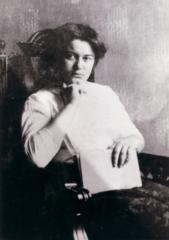
Edith Stein continued writing all through her interrupted Carmelite career, linking philosophy with theology and spirituality. Much of that writing addresses the challenge of the “coherence of meaning” as she explained in her 1935-6 work, Finite and Eternal Being, where she writes, “from God’s point of view – nothing is accidental … my entire life, even in the most minute details, was pre-designed in the plans of divine providence and is thus for the all-seeing eye of God a perfect coherence of meaning. Once I began to realize this, my heart rejoices in anticipation of the light of glory in whose sheen this coherence of meaning will be fully unveiled to me.”
After the infamous Kristallnacht in 1938, when many German synagogues were burned to the ground, the Carmelites quietly moved her to their monastery in Echt in the south of Holland. In 1942, the Gestapo finally caught up with her. She was arrested and transported to the transit camp in Amersfoort and then to Westerbork, before she arrived at what was to become her final destination, Auschwitz. Here, she and the 987 other Jews who were in the same transport were gassed. Edith Stein was beatified in in 1987 and canonized in 1998.
 On this fifth week of Lent, here are three brief perspectives on the Lenten journey selected from the works of this renowned Carmelite, Edith Stein – Saint Benedicta of the Cross
On the power for prayer:
Prayer is the highest achievement of which the human spirit is capable. But it is not merely a human achievement. Prayer is a Jacob’s ladder on which the human spirit ascends to God and God’s grace descends to people. – 1933, (p. 119)
On the Cross:
The eyes of the Crucified look down on you, asking, probing. Will you make your covenant with the Crucified anew in all seriousness? What will you answer him? “Lord, where shall we go? You have the words of eternal life. Ave Crux, spes unica." [Hail the Cross, our only hope.] – 1939 (p. 134)
And this, from her final published work, which speaks to challenges of following the Lenten path:
In the Passion and death of Christ our sins were consumed by fire. If we accept that in faith, and if we accept the whole Christ in faith-filled surrender, which means, however, that we choose and walk the path of the imitation of Christ, then he will lead us ‘through his passion and cross to the glory of his resurrection.’ This is exactly what is experienced in contemplation. – 1942 (p. 158)
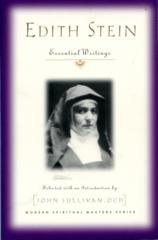
These Edith Stein excerpts are found in Edith Stein – Essential Writings, Selected with an Introduction by John Sullivan, O.C.D., and published by Orbis Books (2002) in its Modern Spiritual Masters Series.
+++++++++++++++++++++++++++++++++++++++++++++++++++++++++++++++++++++++
Next Week: Monty Williams S.J. concludes this Lenten series by directing us to the Ignatian path, a journey “that begins when we realize that we are trapped in a creation – cosmic, human, and personal – that is disordered. The first stage of intimacy carries us to the realization that even here we are loved, protected, and held in God’s love.”

No Comments