



The Sound and the Story – A Four-Part Series for Advent – (1) God is With Us

This Advent, Kevin Burns will listen to some carefully chosen music. In the first in the series he explains why, this year, one piece in particular will take on an even more poignant meaning: John Tavener’s God Is With Us.
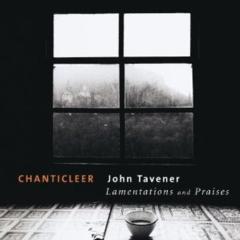
The British composer, John Tavener, described his composition, Lamentations and Praises, as “a liturgical drama” and “the most purely Byzantine piece that I have written, one of the most translucent, tender.” 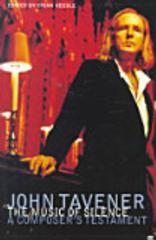
One critic described Tavener’s translucence as “bland and tired” and unkindly characterized the composer as a “dime-store evangelist of the classical music world.”
The work’s title, Lamentations and Praises, captures something of the divided reactions that his music has always attracted. Tavener was a truly gifted artist and a man of deep faith, a musical innovator who explored religious experience. He converted to Orthodox Christianity in the 1970s and in his final years gave increasingly more attention to other religious traditions.
Tavener was thrown into the public spotlight twice during his musical career. In the 1960s and still in his 20s, he befriended the Beatles and became the only non-pop artist to record on their short-lived Apple label. The much hyped 1968 LP of his dissonant and layered oratorio, The Whale, confused listeners expecting to hear a set of three-chord songs with simple sing-along choruses.
Looking back on that work in 2004, Tavener called it “a piece written by an angry young man. I was angry because the world didn’t see the cosmos in metaphysical terms. I was also angry because what I saw of so-called classical music in those days was very po-faced. I wrote The Whale as a reaction in a way. The piece is very fantastical.”
Then, in September 1997, countless television viewers around the world who tuned in to watch the funeral service for Princess Diana heard his mysterious and haunting Song for Athene as her coffin was carried the length of Westminster Abbey and placed on the carriage outside, as the soloist’s final notes echoed inside the building. An overnight sensation, once again.
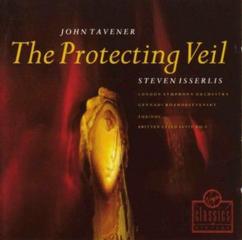 Now, the classical record companies scrambled to get Tavener “product” out into the marketplace. The cellist Steven Isserlis struck gold with his recording of The Protecting Veil, a work he also commissioned, and which has since become a concert and broadcast staple around the world.
The double-edged backlash against Tavener intensified. The music establishment voiced suspicion of his motives, given his ties to religious tradition. The religious crowd could not identify his theology clearly and were confused by his interest in Rolls Royce cars and his close connections to Britain’s royal family. They grew increasingly uncomfortable with what they saw as his relativist approach to religious traditions. Confusing both parties was Tavener’s remarkable commercial success. He was a serious, “classical” yet contemporary composer, with sold-out concerts, and countless commissions. He wrote challenging and accessible works performed almost as liturgies, often in not-traditional spaces, and audiences flocked to attend them. It was confusing to witness a commercially successful artist whose works served a higher purpose. 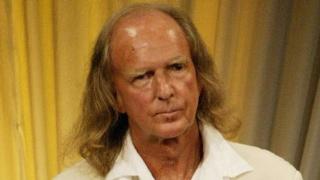
Jeremy S. Begbie understood, though. He is the Cambridge musicologist and systematic theologian who, in 2000, characterized Tavener’s music as something that stops time and creates space. He said it “offers a kind of musical de-compression, an aural ‘space’ amidst a temporally compressed culture, a stable place, in which we are not shoved and driven from ‘here’ to ‘there’. And in a society overloaded with multiple and contradictory communication systems and messages, he provides a simple space – unified and relatively undifferentiated. This, I believe, may well point to a significant factor behind the economic success of his music: our culture’s inability to live peaceably with time.” (Theology, Music and Time, Cambridge University Press.)
 Tavener was helped in his efforts to stop time and create space by an unlikely muse, a reclusive Orthodox nun, Mother Thekla, born Marina Sharf in 1918 in Russia. The Sharfs fled the Revolution, seeking refuge in England where Marina was educated and eventually graduated, in 1940, with an English degree from Cambridge. She worked with British intelligence during the Second World War, taught high school, then gave it all up and to become a nun in the Orthodox tradition. She took the name Thekla and, in 1966, founded a community in the most isolated spot she could find in North Yorkshire. There, she led a life of prayer and contemplation, and occasionally wrote. One of her books caught Tavener’s attention during his own journey into Orthodoxy. They exchanged letters and it was Mother Thekla who eventually gave him the words for Song of Athene, the libretto for his 1992 opera Mary of Egypt, and the texts for several major choral works, including The Apocalypse, We Shall See Him As He Is (both 1993) and Fall And Resurrection in 1999. That year, Tavener dedicated his memoir, The Music of Silence: A Composer’s Testament, to her because she “helped me put my music and my life together.”
This strange collaborative relationship was reportedly stormy at times. Their complex individual lives and their odd yet productive creative partnership would make for a tantalizing opera, but the music and libretto will have to come from someone else. Mother Thekla died in 2011 at age of 93, and John Tavener died on November 12, 2013 at the age of 69. 
On the day Tavener’s death was announced, the young American composer Nico Muhly, an artist fascinated by the music of William Byrd and the early English choral tradition (and a sometime collaborator with Iceland’s impossible-to-define musicians, Sigur Rós), wrote this touching and perceptive tribute for The Guardian:
After his most recent illness, it seemed as if his compositional output had entirely stopped – he described it in the press as a crisis of faith, as a sort of emptiness and silence. He wrote his way out of it, though, creating a series of works in a relatively short time. I happened upon the score to one of these later pieces in my publishers' offices in London last year. It was scored for voices and three string quartets. It didn't seem, as is the way with some composers' late-period works, like a sacred relic or a death-mask. Instead, it seemed like a transparent and honest piece of work heralding the beginning of another decade of innovation, clarification, and sacred simplicity.
 Sacred simplicity lies at the heart of Tavener’s music. As Begbie says, “in a culture where it is often thought unwise for Christian composers to be very overt about their faith, Tavener is unashamedly open.” Why? Because Tavener believed that music was a means of “tapping into a deep longing for the sacred in contemporary life, touching people at a level beyond and underneath emotion, will, and intellect.” Whether people lament or praise it, Tavener wrote that his music, like an Ikon “is beyond art – a real presence that we venerate, looking tenderly at us, helping us to pray, and lifting our minds and hearts above this earth (where we are in exile for a short time) into Heaven, our true ‘Homeland’.”
Tavener’s God Is With Us, can be heard through this link to the King’s College Cambridge Youtube channel. It’s their 2007 performance of a 5-minue piece with angelic floating voices and a thunderous, rafter-rattling organ swell at the end:

No Comments