



Tales from the Inky Way #4 – Drawn into the Mystery – Jean Vanier
Kevin Burns remembers a week in 2003, working on a book with Jean Vanier at the heart of l’Arche, in Trosly, France, a short drive from Compiegne.
When you arrive from Paris at the railway station in Compiégne in Picardy, across from the arrival platform and on the way to the main exit, you pass two old boxcars on a short piece of track, surrounded by a stone pathway on all fours sides. It’s a memorial to those members of France’s Jewish population whose deportation to the French concentration camp at Drancy – and for many, a final destination in a Nazi extermination camp – began here.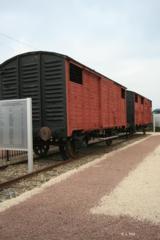
Sitting outside the station in a tiny beaten-up car is Barbara Swanekamp, one of the original members of the l’Arche community. For four decades she worked closely with l’Arche founder, Jean Vanier, until her death in 2007. Before this first meeting in person, she and I had telephoned, e-mailed, and faxed the many manuscript pages that she had carefully typed (though e-mail and attachments were never her favoured medium) regularly for almost a year. These were the component parts, elements of the manuscript that would eventually become Jean Vanier’s book Drawn in to the Mystery of Jesus through the Gospel of John. And this was the week we had set aside for the final editing session, the first face-to-face working sessions I would have with Jean Vanier.
If you’ve ever seen a photograph of Edith Piaf in her final years you have some sense of Barbara Swanekamp, a tiny, fragile, bird-like figure, crippled with painful arthritis, and a formidable force to be reckoned with. She was the no-nonsense gate-keeper, protecting Jean Vanier from the never-ending demands on his time and attention. When we sit in the car she politely asks me if I could turn the key in the ignition as her fingers are so bent she can’t manage it herself. Yet nothing will hold her back from serving l’Arche in any way possible, while she still can. 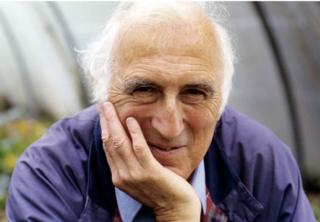
She drives us through the old centre of Compiégne, which is where all the exterior scenes in the 1960 black-and-white film “The Carmelites” (Le dialogue des Carmélites), with the great Jeanne Moreau and Madeleine Renaud, were shot.
On the twenty-minute journey from the station to Trosly we pass a park and another wartime memorial, Le Musée de l' Armistice. This is the railway carriage where France’s Marshal Foch, British, and German officials signed the Armistice that brought an end to the First World War on November 11th, 1918. The same carriage was chosen again by the Nazis in 1940 as the ideally humiliating location to settle details with the powerless French government of the German Occupation of the country (1940 – 1944).
Jean Vanier’s tiny cottage is some distance away from the various communal l’Arche buildings dotted all around the village of Trosly and also throughout this surrounding rolling region of rural France.
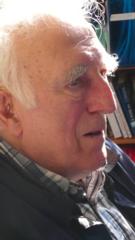 Jean Vanier is an imposing figure, very tall. He tends to stoop, mostly to make shorter people feel more comfortable, I think. We have just one week. We will meet in his cottage from 9 until noon every day. His phone will be unplugged and he will ignore any of the (many) knocks on his door.
His is a difficult manuscript, poetic in scope, and deeply exploratory of his theology and life-long study of the Gospels. I struggle not to be star-struck. I think he’s gently trying to weigh-up this Canadian editor sitting across from him with a laptop computer and every draft of every chapter.
As the time races by, we go through the entire work, line by line, page by page, from start finish, knowing that the book has taken over and that we can relax into our defined roles: accomplished author and determined editor.
Midweek, after one of our morning editing sessions, we walk from the cottage down the hill to Val Fleuri, one of the original l’Arche foyers. Over a crowded table I struggle to follow the chaos of all the cross-table conversations as much of the French I am struggling to translate is also filtered by the various physiological challenges the residents are living with.
After a few sips of soup, the community member sitting next me puts his hand on one of the medical braces that cover my wrists, the result of a neurological condition. I wait for the inevitable question or observation which I hear time and again: “What’s wrong with you?” or “I have carpel tunnel problems as well.” But that’s not what happens. He pats the brace, looks me in the eye, and says, in French, “Oh, that must be very painful. I’ll pray for you.” He keeps patting as he sighs a long drawn-out sigh, and in that moment of silence between us I find can’t find any words in any language. Drawn into the mystery.
Back in his small stone cottage, Jean Vanier and I go through the entire work one final time. When we finish, I ask him the question that I ask every author I work with: “We’ve done a lot of work on this. I need to know from you, is this still the book you intended to write?” And I pause. He smiles, nods graciously, and I am relieved to hear him tell me that it certainly is. Then he does something that will forever be the way I remember Jean Vanier. He says he’s a bit peckish and invites me into his tiny cluttered kitchen where he makes a cup of tea and spreads some soft crumbly cheese on a slice of really course bread. We have a final little snack together.
That evening, from a hotel room in Paris,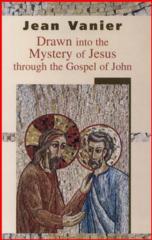 I send an e-mail back to the publisher in Ottawa informing him that we’re ready to go to page layout. In 2004, the book that many observers describe as one his most moving and engaging works, Drawn in to the Mystery of Jesus through the Gospel of John was published simultaneously in Canada, the United States, and the United Kingdom.

No Comments