



Jesuit Education and A Young Politician


Since I graduated from St. Paul's High School in 2014, I have constantly reflected on how the Jesuit tradition has shaped me into the young man I am today. Over the Christmas break, I participated in the 95th Youth Parliament of Manitoba. The Youth Parliament of Manitoba is one of the oldest model parliament organizations in the Commonwealth, having held its annual Winter Session at the Manitoba Legislature in Winnipeg annually since 1922. During the 5 days of the Session, I kept asking myself "how can I relate this experience back to my time in high school?". Then I remembered 5 principles that I was taught all through high school at St. Paul's: the "Grad at Grad", which are 5 ideal characteristics that the Jesuit pedagogy strives to foster in their students: Open to growth; Intellectually competent; Religious; Loving; and Committed to doing justice. 
When I think of someone being "open to growth", I think of being able to compromise with people with whom you may not entirely agree, and accept outcomes that you may not agree with; politics is no exception to this ideal. Canada, like other countries in the Western world, is a developed, liberal democratic society. For democracy to function properly, difficult decisions must be made, knowing full well that not everyone will be content with the outcome. One such example I can think of from Session was a bill we debated that essentially removed quantitative assessments (number/letter grades, GPAs, rubric grades, etc.), and replaced them with more qualitative assessments (comments on an exam/test/essay).
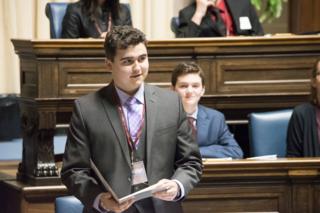 The argument behind this bill was that it would reduce competition in classrooms between students, and reduce anxiety for students as they prepare for assessments. I spoke out against this bill, using the George Orwell book Animal Farm as an example in my case. In the novel, farm animals remove an abusive, oppressive farmer, establish their own regime where they are in charge, only to see the regime be more oppressive than before. Despite my case, the bill passed, even though I do not agree with the bill.
Being intellectually competent means being able to ask tough questions based on research. Most of my arguments were based on domestic and international law, specifically the Canadian Constitution, and the Universal Declaration of Human Rights, passed by the UN in 1948. Since I am a political science student, I am comfortable using this research to form arguments in debate, and ask questions in our Question Period.
Being religious means having devotion to God in what they do. We would have a moment of silence prior to every sitting, since YPM is a non-denominational organization. The Church is very important to me, so important that I would say a prayer before each debate, asking God to bless me to serve His Greater Glory (Ad Majorem Dei Gloriam). To remind me of this call to service to God, I wore a medallion that said “St. Paul, Pray for Us” with an image of St. Paul on it, and my Jerusalem cross from my Kairos retreat.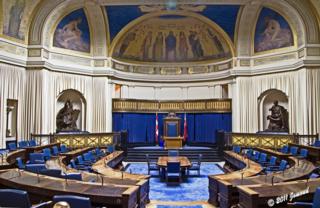
Throughout Session, the most important ideal is the graduate being loving. Over 5 days, many of our members do not know each other, and eventually become close friends since we all live together during those 5 days. One example which especially comes to mind is when I stayed up late to help someone with a critical speech they gave the next day. This is one specific example, but since all members lived together during Session, interactions between backbenchers, members of Cabinet, and our 5-member board of directors were very strong.
The last aspect of the “Grad at Grad”, committed to doing justice, was also apparent, especially during this year’s Session. To me, being committed to doing justice means challenging social injustices and promoting change. Over the past 2 years, we have invited Indigenous elders to perform smudging ceremonies. Following this year’s ceremony, I apologized to the elder with tears in my eyes on behalf of the Catholic Church, for the harm that was caused to them through residential schools.
 We also debated a bill that would legalize all forms of polygamy and plural marriage, which eventually passed. Those who practice polygamy in our society are often persecuted because their lifestyle is contrary to the norm of monogamy in our society; however, in the Gospel of Matthew, Jesus says “Blessed are those who are persecuted, for they are children of God” (Matthew 5:11). In addition to Christ’s message, politicians such as Pierre Trudeau, who is quoted as saying “the state has no place in the bedrooms of Canadians”, has also shown a commitment to doing justice on the part of politicians.
A Jesuit education can be applied to any aspect of life, especially politics. I am very grateful for being able to grow as a young person with the help of a Jesuit education, and apply this to the world of politics.

No Comments