



Who By Fire?


In keeping with the recent demise of Leonard Cohen, I borrow this title – "Who By Fire" – from one of his songs, but the text I want to comment on is from the 33rd Sunday in Ordinary Time:
“See, the day is coming, burning like an oven,
when all the arrogant and all evil doers will be stubble;
the day that comes shall burn them up,” says the Lord of hosts,
so that it will leave them neither root not branch.
“But for you who revere my name
the sun of righteousness shall rise,
with healing in its wings.”
The Book of the Prophet Malachi 4:1-2
The prophecy points to messianic times, but we can read it as meant for our own times, which appear more and more apocalyptic, if not messianic.
The gospel passage for this Sunday is itself a little apocalypse, with Jesus foretelling not only the fall of Jerusalem (check mark) but also later wars, insurrections, earthquakes, famines, and plagues (check, check, check, check, and check). He warns us not to be led astray by anyone claiming to be the Messiah (use those Second Week Rules for Ignatian Discernment!) and not to be terrified (use the First Week Rules too!), and not to go after people when they say “I am he!” and “The time is near!” Perhaps the Second Coming is not imminent. But there are disasters all around us, and it’s the ecological crisis which seems to be creating more and disasters in many, many places. Let us focus on fire.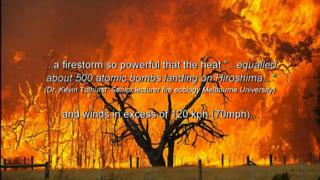
Some years ago there was published a large book of photographs chronicling the growing number of bush fires in Australia. It’s title is Firestorm: Black Saturday’s Tragedy—Australia’s Worst Fire Ever (Glenvale School, Lilydale, Victoria, 2009). This year the fires there have already begun in early November, which is unheard of until now. Summer, when the temperatures soar above 40C, does not officially begin in the southern hemisphere until the 21 December. Fires in Australia have been growing in size and intensity in the eucalyptus forests, and have become impossible to control.
We are reminded of our own recent experience of the forest fire near Fort McMurray in northern Alberta, which was vast and uncontrollable until it burned itself out. Such fires are becoming more frequent in the boreal forest which covers much of the northern hemisphere in Canada, Alaska, Siberia, Russia, and Scandinavia. This forest has been called the lungs of the earth, for its role in absorbing carbon dioxide and giving off oxygen. However, with shorter winters and the earlier melting of snow, the northern forests have been drying out for lack of moisture. Insects have also been advancing further north with the warming climate, damaging the trees and leaving them like tinder. Wherever lightning strikes, these resinous trees explode in flame, and great swaths of forest are quickly consumed, even when there are no high winds. Water bombers are almost useless against such fires, and firefighters are being forced to develop new strategies.
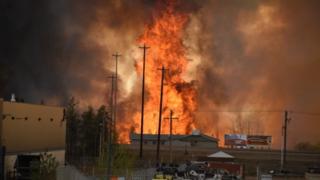 Add to this the recent forest fires in the Indonesian gum forests, and the perennial grass fires in California: the big picture looks grim indeed. While it is important to do what we can to lessen our use of fossil fuels, what we burn is being dwarfed by the burning of wildfires around the world. If this sounds like pessimism, it is. If it seems apocalyptic, it does. Where, then, is hope to be found?
Hope is not simple optimism. Hope and faith are two sides of the same precious coin, which is love itself. My hope lies in the fact that God so loved the world that he gave his only Son, so that whoever believes in him should not perish but have eternal life (John 3:16). God, who did not spare his own Son but gave him up for us all, will he not also give us all things with him? (Romans 8:32) The cross of Christ, then, is the true ground and chief cause of Christian hope (Leo the Great). What this seems to say is that belief in the resurrection must be grounded in the reality of Christ’s crucifixion. Only by gazing steadily and unflinchingly at the cross of Christ will I be able to hope against hope (Romans 4:18) and believe that, come what may, God will be with me, that Jesus will be with us, and will raise us up with him.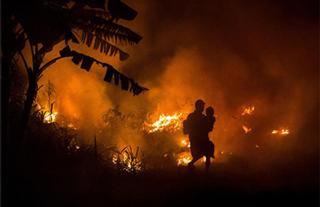
In turning to the Apocalypse itself, the Book of Revelation, we are given a vision of the end, a vision not of a funeral but of a wedding:
Then I saw a new heaven and a new earth; for the first heaven and the first earth had passed away, and the sea was no more. And I saw the holy city, the new Jerusalem, coming down out of heaven from God, prepared as a bride adorned for her husband. And I heard a great voice from the throne saying,
“See, the home of God is among mortals.
He will dwell with them;
they will be his peoples
and God himself will be with them;
he will wipe away every tear from their eyes.
Death will be no more;
mourning and crying and pain will be no more,
for the first things have passed away.”
The Book of Revelation 21:1-4
This is my hope, this is my faith, founded on the compassionate love of God revealed in the crucifixion, the cross of Christ.

No Comments