



A Guide to Reading The Bible #32 – The Book of Proverbs

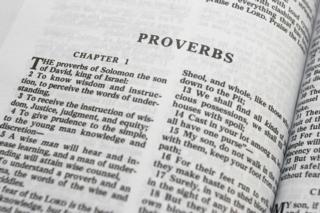
The “Sayings of Solomon” is the title of the Book of Proverbs in the original Hebrew. The word “sayings” expresses better than “proverbs` what the book is all about. For us the word “proverb“ means a short, pithy saying to express a truth or to point a moral lesson. The older sections of the book are confined to these short sentences, but the other sections are more elaborate, containing parables, allegories, and discourses. For example, almost all of the first nine chapters is in the form of a father giving advice to his son.
Proverbs is part of what is known as wisdom literature, which flourished in the ancient East. The authors of this literature, known as sages, were teachers of the art of successful living, transmitting to successive generations the accumulated knowledge of the past. They were not concerned about religious thought as such but rather with human solutions to life’s problems.
The Israelites had learned much about the art of successful living, and the one who knew more about it than anyone else was Solomon, the son of King David. The sages of Israel ranked him above the wisest men of all nations from the beginning of time. “Yahweh gave Solomon immense wisdom and understanding, and a heart as vast as the sand on the seashore. The wisdom of Solomon surpassed the wisdom of all the sons of the East, and all the wisdom of Egypt” (Kings 5:9-10).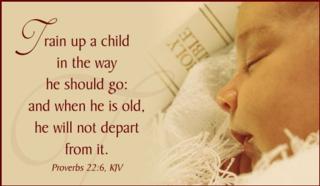
Although the book is supposed to contain the sayings of Solomon, it includes the sayings of other sages as well. Solomon’s words of wisdom are confined to Chapters 10:1 to 22:16 and 25:1 to 29:27. These chapters are the most ancient of the book, and there is no reason to doubt that the maxims in them date to the time of Solomon. But it is impossible to refer an individual saying to him with any certitude. There is no particular plan to these chapters. Indeed, they are just a collection of brief sayings, usually in couplet form.
The Book of Proverbs is written in verse like the principal part of the Book of Job. The style is simple, graphic, picturesque as one would expect to find in basic teachings handed on from generation to generation. We have a similar style in the weather maxim” “Red sky at night, sailors delight; red sky in the morning, all men take warning.”
The purpose of the book is expressed in the first seven verses: to lead men to accept the teaching of wisdom. The purpose is realized not by a series of speculative questions about wisdom but by a presentation of graphic examples and by prudent advice. Wisdom is not presented as a learned subject but as pragmatic rules of conduct which make a man practise virtue and render him prudent and happy. The names given to the book by some of the early Fathers of the Church help us to appreciate its beauty. For St. Gregory Nazianzen, it was “the youth-instructing wisdom,” and for St. Clement of Rome, “the all-virtuous wisdom.”
 In reading the book we should take into account that these ancient authors, the Israelite wise men, had no knowledge of life after death. Much of the counsel offered has an apparent secular character with self-interest and personal success appearing as adequate motivation for ethical conduct. However, religion was also an essential part of every phase of man’s activity, and in all things, man was subject to the divine will. So just as the nation would prosper materially if the people were faithful to the Law of God, so also the individual would prosper in this life. The Book of Job tried to solve the problem of an individual not prospering despite his obvious holiness. Only the revelation of life after death which came with the New Testament resolved the problem. But even the Christian has to appreciate and to love the goods created by God, and a person cannot be pious and devout without first being honest, prudent, and reasonable. The Book of Provers is quoted fourteen times in the New Testament and alluded to many more times.
In the prologue of Chapters 1-9, wisdom is personified as a woman who makes her appeal in public inviting men to a better life. And she appears as Divine Wisdom at once present in God from eternity and acting with Him in the work of creation. Personified wisdom appears in other wisdom literature in very striking expressions. However, the personification does not seem to be more than a poetic device because the Old Testament forbade the multiplicity of gods. At the same time, the passages prepare the mind for a revelation of three Persons in one God to come in the New Testament, e.g., in St. John’s Gospel we have the Word who is in God and outside Him like Divine Wisdom. All these impressive texts find their deepest fulfillment in the Incarnate Word – Christ.
We must mention the concluding verses of Proverbs, Chapter 31: 10-31, which give a portrait of the ideal wife, a section used frequently in scripture readings at liturgical services in honor of women. “A perfect wife – who can find her? She is far beyond the price of pearls.”
The strength of Israel, as of any nation, depended on learning from the mistakes of others and following the crystallised wisdom expressed by its sages of whom Solomon was the greatest of all. What a shock it was for those scribes and Pharisees who asked Christ for a sign that He was all that He claimed to be when they heard Him referring to Himself as “something greater than Solomon Jesuits Infirmary here” (Mt 12: 42).

No Comments