



A Guide to Reading The Bible #30 – The Book of Job


The Book of Job is a masterpiece written by a literary genius. We do not know the name of the author or any other explicit information about him. What we do know comes from what he wrote about Job. The information is a great deal for we see a man capable of the finest as well as the most upsetting emotions. No doubt he was an Israelite with a thorough knowledge of the prophets and the teaching of the sages.
Throughout the ancient East there was a great deal of literary work known as wisdom literature. This “wisdom” ignores national boundaries. It gives little attention to religious thought for it is concerned with human solutions. It treats of the meaning of life by an appeal to experience and provides a recipe for successful living. Fables and proverbs are examples of wisdom literature. In the Old Testament there are five “wisdom” books: Job, Proverbs, Ecclesiastes, Ecclesiasticus, Wisdom. Those who belonged to this school of thought are known as sages.
The sages of Israel resemble the sages of neighboring races. They show no concern for the history of their nation nor for what the future has in store. The individual and his destiny are their main themes. However, due to the revelation inherited from their religion of Yahweh, the wisdom of Israel is essentially superior for the contrast is between virtue and vice rather than between wisdom and folly. Also, there is contrast between true religion and false religion, because real wisdom is found in the fear of God which is the authentic foundation of true religion.
It is not known when the Book of Job was written. The best conjecture places the date between 600 and 300 B.C. The author chose an old story which no doubt was familiar to his contemporaries. In the ancient past of Israel there were three legendary figures, Noah, Daniel and Job who were models of righteousness. They appear in Ezekiel 14:14-20. The author retold the story of Ezekiel’s Job in a careful imitation of the antique style but increasing severity of Job`s trial. Also, he introduced three wise friends. Of course, the Book of Job is not history. The author is not relating an event.
The problem is: Why does the just man suffer? The just man is Job who certainly was a faithful servant of God. When the story begins, Job is rich and happy. God allows Satan to test Job to see if he will remain faithful despite misfortune. Misfortunes of all kinds come to Job for he loses all his possessions, his children, his health, his friends – except the three who can see no solution to the problem other than that Job has sinned. This is the traditional solution of the time. A sinner is punished on earth.
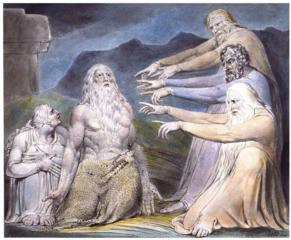 But Job will not accept this answer because in his conscience he knows that he is innocent. His friends grow more and more obstinate as Job continues to reject their conclusion. But repeatedly, Job is brought up against the mystery of a God of justice who makes the good man suffer. A tortured soul is added to the torments of diseased body.
The greater part of the Book is in poetic form. It is the longest ancient Hebrew poem which has survived and perhaps was ever composed. The prologue of Chapters 1 and 2 sets the stage. It is in narrative form and tells how Job arrived at such a sorry state. The poetic form begins with Chapter 3 and remains until the epilogue of Chapter 42, verse 7. Job`s three friends arrive at the beginning of Chapter 3 and the dialogue continues through Chapter 31. A previously unannounced younger man named Elihu arrives in Chapter 32 and remains until Chapter 37 while he has his say with Job replying nothing – all, at times, characteristic of younger men. The rest of the poetic section is taken up with Yahweh`s speeches and Job`s humble replies.
Because most of Job is in Hebrew poetic form, a word should be said here about the basic construction. What is stated on one line is repeated in a somewhat different way on the second line and at times, on a third line. We have examples of both in Job 3:3-4:
May the day perish when I was born,
and the night that told of a boy conceived.
May that day be darkness, may God on high have no thought for it,
may no light shine on it.
Scripture scholar, Father R. A. F. MacKenzie, S.J., has an excellent summation of the Book of Job and the problem of God`s justice in the Jerome Biblical Commentary:
“The book is full of paradoxes, for it attempts to approach divine truth, incromprehensible to man, from various viewpoints. It is essential to the lessons that Job should be a lover of God, a saint. Otherwise, his affliction would contain some proportion of just punishment. Furthermore, only such a man could support the test. This observation should temper the scandal some readers feel at what they call the callousness of God in Chapters 1-2. We are meant to understand that God trusts his servant to serve himand that this is Job`s opportunity. We may compare this concept with the Christian theology of martyrdom. The martyrs, beginning with Stephen (Acts 7) and Ignatius of Antioch, have not accused God of injustice or cruelty in requiring of them the extreme sacrifice; they willingly offer him this ultimate testimony of love (Jn 15:13). But for the encouragement of less eager martyrs, there is the example of the prayer in Gethsemane in which even God`s own Son uttered his lament and prayed to be spared his trial.“

No Comments