



It Takes a Village to Raise a Missionary
Sometimes a missionary may have to go home to remember what it means to be a missionary. I learnt this not by returning home myself, but by accompanying a brand-new Jesuit priest to his hometown to celebrate a mass of thanksgiving. I myself, in fact, was very far from home: I am spending the summer in Brazzaville, Congo, working at Centre Vouéla, a Jesuit retreat centre. During my stay, I worked alongside Christophère—now Fr. Christophère—who was ordained here in Brazzaville a few weeks after my arrival. The following weekend he very graciously invited me to join the group making the long journey to Ewo, a town 600 km from Brazzaville where he was born and raised.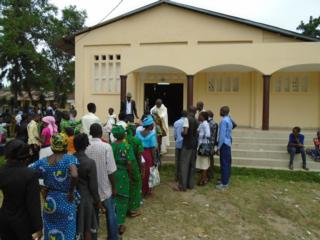
There were twelve of us on the trip: a handful of Jesuits, including one of his novice classmates, two young sisters and a couple of lay friends. We crammed into two trucks and spent the day travelling, mostly over well-paved roads, but contending with stretches of potholes and a longish unpaved section that would have been quite difficult in the rainy season. When by dusk we finally drew near our destination, we discovered a group of enthusiastic people waiting by the roadside. They had come out to meet the town’s favourite son so that they could escort him to the parish in style. And so, much to Fr. Christophère’s embarrassment, we were preceded by a vehicle and a parade of motorcycles honking their horns and playing their alarms to let everyone know that the new priest had arrived. When we arrived at the parish, where we were put up, a crowd was waiting to wish him well.
The following day was a Saturday and we were able to rest and see a little bit of the town, but the big day, of course, was Sunday. It is a well-known joke that new priests celebrate many ‘first’ masses, and Fr. Christophère had already done of few of these before he arrived in Ewo. But this was really the most important of his first masses, for it was in the parish in which he had received the Catholic faith. By the time the service was underway, there was standing room only—and that outside, for the church building itself was full.
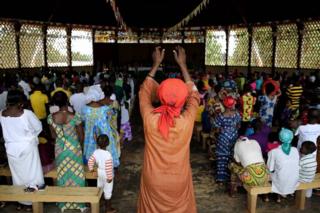 Anyone who has attended mass in Africa will not be surprised to hear that the service was almost four hours long. There was a lot of singing, much dancing, an offertory precession that took about half an hour, and even, before the final blessing, a moment where Fr. Christophère and some other clergy were seized up by joyful throngs and carried around the church amidst more singing and dancing. The moment that crystallised the whole event for me, though, was when Fr. Christophère said a few words of thanks at the conclusion of the liturgy. After singling out many important individuals, he looked out at the congregation and thanked everyone for the gift of his vocation. It was not, he explained an individual choice to become a Jesuit priest, but he was given by the community. And he said that while he may have travelled to many countries as a Jesuit missionary, everyone in the church was a missionary, because everyone there helped to send him forth.
And so, Fr. Christophère was finally home again to meet his fellow missionaries. I realised in a new way on that day that a priest is not ordained for himself but for others. But if Fr. Christophère is at the service of his fellow Christians, it is true that they too are at his service. For it was they who set him out on his journey, and it is their prayers and sacrifices that will continue to support his future missions.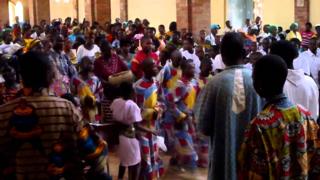
That evening there was a feast in Fr. Christophère’s honour at his family home, and the joyful celebration continued. His novice classmate, a Rwandan, noted with approval that whereas in Rwanda celebrations of that kind are dominated by long speeches, here in Congo there is food and drink and then people get down to business: music and dance. I may retain my Canadian reserve and shyness in such settings, but I certainly agreed with the sentiment, for there was a lot to celebrate. Ewo has not only produced a Jesuit missionary. Ewo itself is a town full of missionaries.

No Comments