



National Aboriginal Day – June 20, 2016
On this National Aboriginal Day, the indigenous peoples of Canada find themselves in a stronger position than in many years. There remains an incredible gap between the opportunities afforded to non-aboriginal Canadians and aboriginals, but government, business and religious leaders are taking action to narrow that gap. Awareness means that present and future leaders will have a difficult time reneging on promises. The Jesuits in English Canada have stood with the First Nations of Canada for a long time and accompaniment remains a high priority.
I thought it would be helpful to inform readers of a few initiatives in Regina, SK that may not be well known in other parts of the country. Some very creative work is happening with the First Nations peoples in Regina.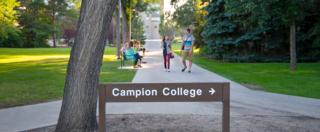
Upon his retirement from university teaching in 1999, Fr. John Matheson, S.J. began an active ministry in the local prison that held a large number of indigenous people. Out of concern for what became of them after their release, he and others established Friends on the Outside (FOTO). Supported by the Archdiocese of Regina and benefactors, FOTO assists the families of prisoners, as well as aiding those released from prison by helping them to reintegrate into society and by advocating on their behalf.
 In 2011, with the inspiration and financial assistance of lay groups in Regina, and with the strong encouragement of the local Jesuits and Campion College, Canada’s first Nativity School, Mother Teresa Middle School, was begun. Part of a larger global network begun in 1971, the school is the first one to reach out to indigenous people by adapting to the local context the Nativity model of educating young people from underprivileged backgrounds. (A similar school, Gonzaga Middle School, is in the planning stages in Winnipeg, MB.)
Campion College has good relations with the First Nations University of Canada and with the Aboriginal Students Association of the University of Regina. Its president, Fr. John Meehan, S.J. actively develops these relationships. He also assists with Mass at a couple of First Nations communities just outside the city of Regina.
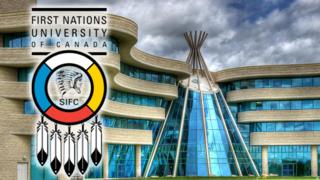 This summer we have initiated an immersion program in indigenous life for our young Jesuits in formation. The handful of scholastics taking part in this initial experience are benefiting from the many opportunities in Regina. In addition to the above projects, they are taking two courses offered at the First Nations University of Canada. Perhaps we can get one or two of the participants to write about their experience.
Our Development Office in Toronto organized several events for this month. On June 4 Anishinabe Spiritual Centre in Espanola had a Jesuit tribute, ceremony, and reception to honour the late Basil Johnston. Johnston was a teacher of the Ojibway language, history, and mythology. He was educated by Jesuits in reserve schools in Ontario and at Loyola College in Montreal.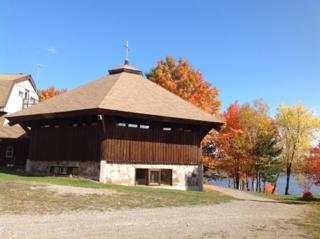
On June 19 Our Lady of Lourdes Parish in Toronto hosted an event: “Healing Through Sharing.” Three residential schools survivors shared their experience and vision for Canadians and Christians.
An earlier posting mentioned a one-day event to mark the first anniversary of the TRC events in June 2015. "Truth, Reconciliation and Hope: A Vision for a New Canada." The Conference is being organized for 22 June. This event promises to bring together a rich diversity of participants. It will take place at the University of St. Michael's College in partnership with St. Michael's and the Jesuits in English Canada.
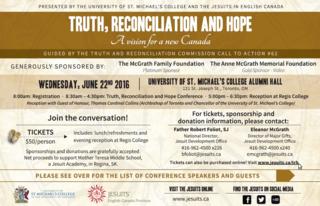 The conference has four major sections.
Section One is "TRC – Listening to Those Were There." Among the speakers in that section are Knowledge Keeper Noel Starblanket, from Saskatchewan and a residential school Survivor. Others are Dr. Marie Wilson, one of the Commissioners of the TRC, and The Right Honourable Paul Martin, former Prime Minister. The first section will include a reading by Fr. Bisson of the Statement of Reconciliation presented to the TRC by the Jesuits in English Canada in April 2013.
Section Two features a panel on "The Treaties, their impact and moving forward to hope." It includes Charlie Angus, the NDP critic for Indigenous Rights and author of "Children of the Broken Treaty." Mr. David Nahwegahbow, solicitor for Nahwegahbow Corbiere and possibly two Grand Chiefs from the First Nations.
Section Three is entitled "Listening today, hope for tomorrow: Reflections on what has been heard by Canada's next generation of leaders." Several young people are being asked to speak to the conference issues and what they believe will follow for the future in Canada.
The final section deals with "Education as the key to the future," taking up #62 of the Calls to Action.
No Comments