



The Children, The Two Standards and The Force Awakens (Part 1)

“And when they arrived, they gathered the church together and declared all that God had done with them” (Acts 14:27). Paul and Barnabas returned to Antioch with what must have been wonderful stories.
With this phrase, the need to present, discuss, evaluate and reflect becomes obvious, and so I am writing to seek comment, perhaps to enlighten, but at the very least share some of the joy I experience working with grades 4,5, and 6 during Sunday school at St. Pius X in St. John’s. 
It isn’t all roses. I’ve learned that if the students start making paper airplanes with their handouts, don’t correct their paper airplane construction technique. I was disgusted at how clueless they were at making paper airplanes, so I showed them how to make one properly. Thank goodness class does end.
We call upon the Holy Spirit to join us in our room, and then I often do a check-in, to see how each student’s week has been. We call upon the Spirit to guide us with wisdom as we read the Gospel of the day. 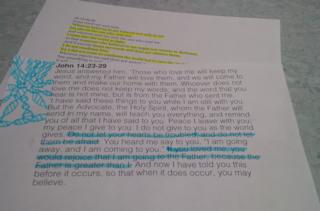 Students have a highlighter, and I have taught them to listen and read along as I read, and they highlight what the Spirit inspires them to notice. Their inspired choices of phrases lead the discussion of the reading.
The three types of love as described by Benedict in Deus Caritas Est led to the discussion of agape – “You don’t have to like someone to love him.” Although we might not like the way someone is or what he does because it is bad or evil, we can still hope and pray to God that he straightens up; we love him in the sense that we want the best for him. Kids can catch on to that pretty quick.
 I decided we would make a list of people that we didn’t like, the “agape” list, and we would pray for them. Top of the list: Donald Trump! They had grave concerns about kicking the Muslims out, and building a wall, and throwing out Mexicans; our action plan: if we were in America, we would tell all our friends not to vote for Donald Trump. We prayed he would get straightened out.
God’s infinite love, as exemplified in the readings that precede the Principle and Foundation, was the focus of the fall. My goal was to realize the constant presence of a friend in Jesus, who would be with them through thick and thin. 
God’s love is a light that shines on us, and then through us. People who shine from within don’t need the spotlight. This light of Christ was a way of understanding not only the humility but also the absence of anxiety in not needing to create the light, but just to transmit it. It made it easy to understand trying not to create a shadow, but a clear window for that light to shine through.
To believe that God is always there, they had to understand God is in everything. That was fun. I had a slide show in which they had to find God in a wide variety of pictures. We acknowledge the presence of the Spirit in our room, outside in the sky, and in the wind blowing the branches around. With God present in everyone and everything, we could understand that everything in our world was a gift from God, and an opportunity for us to find our way closer to God.
Crafts and cards we sent at Christmas 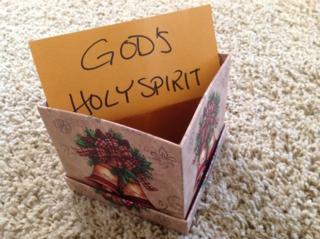 were used to demonstrate how we could be contemplatives in action. Learning the examen, and in doing so, learning how to reflect and then make a decision was not easy for this age, but I could tell that some could use it. We did one at the end of this year, unwinding it to see how everyone felt we did. We talked about what was good, what wasn't. The Christmas cards and crafts are definitely on for next year, as well as a visit for lunch with the elderly at St. Patrick's Mercy Home, something new for our action piece.
With Lent came the ideas of giving things up, something we usually associate with sacrifice and suffering. I had them write on pieces of paper their favourite screen time activity, their favourite candy, and their favourite TV show. I collected all the pieces of paper in a clear plastic container. Then I spilled them out on the desk and emptied it. I asked what was left. 
I explained that what was left was room – room to think without distractions, room to change things they always wanted to do differently. Lent is a time for reflection and change, the Christian’s time for resolutions, like New Year’s is for everyone else. This was our time to take advantage of the opportunity of room to change for the better.
When debating what we could do after emptying the container in the Lent story, one child piped up, "You could do the examen during Lent" as a means of reflection. Just like that, not in a see-how-smart-I-am tone. It puzzles me how prayer can be so matter-of-fact for kids; it can become for them, even in such a complex form, so natural as that.

No Comments