



The Jesuit Refugee Service in Nepal
On the wall of a tiny classroom in a Bhutanese refugee camp in eastern Nepal is a hand-painted sign that reads, ‘An education is one thing you never leave behind.’ 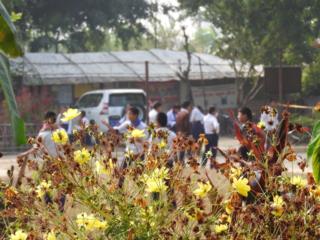
Established in the 1990s by the United Nations High Commissioner for Refugees (UNHCR) to deal with a massive influx of Nepalese refugees from Bhutan, the camp has settled more than 100,000 refugees since about 2007. With such an astronomical population, the needs are diverse. Nevertheless, the Jesuit Refugee Service (JRS) has combined efforts with groups such as CARITAS International and the International Organization for Migration (IOM) to facilitate the resettlement of refugees to various host countries across the globe.
I was fortunate enough to visit in December 2015, and I learned that each of the many associated organizations has a unique focus. It was not a surprise to discover that the JRS is dedicated to the educational needs within the camp. At a variety of sites located near the Nepali and Indian border, the JRS staff work tirelessly to ensure that the many refugee schools are organized and adequately staffed. 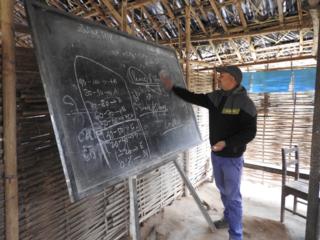
With over 19,000 students remaining in the camp today, the operation is immense. Nevertheless, the collaborative efforts of Jesuits and their dedicated partners are apparent to anyone who visits.
The simplicity – yet functionality – of the classrooms is striking. Although some are developed—with concrete floors and timber frames—most are nothing more than bamboo scaffolds with thatched roves and dirt floors. Despite their rustic nature, each classroom has the essential elements needed for successful lessons—a blackboard, desks, paper, pencils, books, and (of course) a teacher.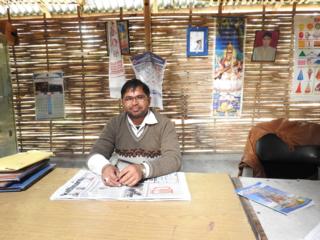
As a Jesuit educator myself, particular attention was given to how perfectly organized the system in the camp seemed to function. Today, because the resettlement process is nearing an end, the school population hovers around 19,000 students. All the same, with the help of the JRS and other associated organizations, there were enough schools and staff to educate more than 30,000 students at its height in 2007.
Teachers are historically selected from among the refugee population, and they each receive foundational training and a small incentive to teach. However, because of the resettlement, teachers are often moved out of the camp unexpectedly. New teachers – often with nothing more than a high school diploma – are often moved quickly in to ensure the educational process continues.
Despite these limitations, my experience revealed that teachers and students were deeply committed to the entire program. Teachers taught science, math, English, social studies, as well as Bhutanese history to eager and happy students. It was a delight to see how the opportunity to attend school was seen as steps leading toward a better future—and not merely tedious endeavour that occupied the day.
My own narrow focus often leads me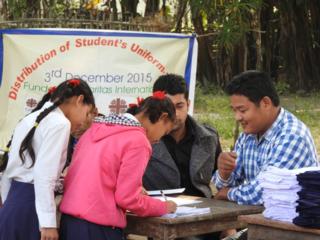 to overlook the ways that Jesuits and their partners are doing such inspirational work around the globe. All the same, this recent visit to the Bhutanese refugee camp in Nepal revealed to me some of the ways that my brothers and sisters labour (in our shared mission) to make the world a better place. In the small country of Nepal and in many other places, the Jesuit focus on pedagogy continues to ensure that no matter what may come in the lives of children—they will forever carry with them a solid education.
+++++++++++++++++
All photos courtesy of Jeff Burwell, SJ

No Comments