



A Guide to Reading The Bible #16 – The Book of Revelation
The last book of the New Testament is now known as the Book of Revelation instead of its Greek equivalent, Apocalypse. By revelation is meant any writing that claims to include a revelation of hidden things, imparted by God, and particularly a revelation of events hidden in the future.
In Jewish writings there were many similar apocalyptic or revelation books in which the future was described in veiled terms, by means of images, symbols, allegories in which numbers, colors, precious stones and animals have their special functions. Some of these are in the Old Testament The Book of Daniel: Isaiah 24-27; Zachariah 9-10; Ezekiel 37:1-14; 40:1 ff).
From the first century B.C. to the second century A.D., books of revelation appeared in great quantities. The authors always concealed their real names, assuming instead a famous man of the past. No one dared to write a prophetic book under his own name because for centuries before the Christian era, prophecy was believed to have vanished from Israel. Despite the sometimes fantastic contents, these writings had a very practical purpose. They were written in troubled times to give their readers consolation and courage, as well as confidence in God whose divine providence directed men`s lives. They taught that God would eventually bring good out of evil.
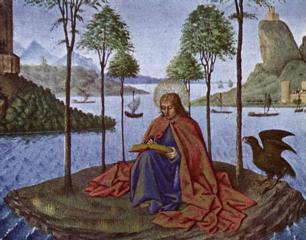 John`s Book of Revelation was written to encourage the Christians who faced the persecution of the Emperor Domitian. Their numbers had been decimated by this first of the Roman Emperors to declare himself a deity and force a choice between adoring Christ and adoring Caesar. The resulting conflict over fundamental principles between Church and state was one of the main reasons why this book was written. Christ had foretold such trials but now there was the question of the meaning of such a conflict between the Empire and the Church and of what would be its outcome. Would the Church have the power to survive persecution or if that was to be its habitual lot? What of Christ`s command to evangelize the whole world? What of the Messianic triumph in which Christians hoped? Would the Church overcome the Empire? It was in reply to such problems that John wrote this prophecy, concerning the future of Christianity, while he was in exile on the island of Patmos. It was written in the reign of Domitian about the year 95 A.D.
This book was born of prophetic, ecstatic experience when the risen Christ appeared to John on Patmos and commanded him to write down the visions he would receive and to transmit them to the Churches of the Near East.
What John saw in his visions was not the images or events which he describes in his book. He received in ecstasy ideas and truths from God which concern the future of the Church or of the infidel, anti-Christian forces. John clothed these ideas and truths in symbols and figures which he borrowed from Old Testament prophetic and revelation writing. However, John used these symbols and figures with great originality.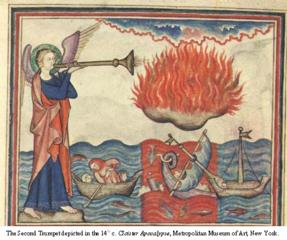
How to understand what is written in the Book of Revelation is a special problem. John’s Book of Revelation is like other New Testament writings. It proclaims Jesus Christ as crucified, risen, eternal Son of God, redeemer of humanity,. enthroned at God’s right hand, future judge of the living and dead. This book conceives the end of all things as the working-out and perfection of these events which were inaugurated by His coming (12:1 ff),
Jesus Christ appears in the Book of Revelation as the master of human history; it is He alone who opens the seal of the book containing history’s secrets.
Again we ask how can we understand what is in the Book of Revelation? The simple answer is that we have to rely on Scripture scholars to guide one’s reading and not on a vivid imagination. We present an example of this kind of help provided by one of my Scripture professors of long ago, the late Father David Stanley, S.J. Here is what he taught about “the lamb with seven horns and seven eyes (5:6); the beast with seven heads and ten horns” (13:1
“One must content oneself with an intellectual apprehension of the symbols. The number seven being perfect and so representing fullness, the seven horns and seven eyes mean the lamb has fullness of power (=horn) and of knowledge (=eye), while the beast is probably a symbol of the Roman Empire with seven emperors and ten vassal-kings.”
I trust that the above example helps to show the need of the guidance of Scripture scholars when reading the Book of Revelation.

No Comments