



A Guide to Reading the Bible #12 – Epistle to the Hebrews

There is no agreement among Scripture scholars about who wrote the Epistle to the Hebrews, when, where or for whom. Despite this lack of agreement on so many points, all agree that is one of the most important books of the New Testament.
Until the end of the fourth century, the Western Church denied that Paul had written it, although it was known very early and was .widely used. In the Eastern Church, despite many reservations about who was the author, it was accepted everywhere as canonical or inspired by God. After the fourth century, it was accepted in the West, too. It is classified as Pauline, that is, as taking its main characteristics from the teachings of St. Paul.
The Letter to the Hebrews is aimed at a fundamental problem that is still with us today. The author was writing for Christians who are tempted to love a world that is the very enemy they must conquer after the example of Christ. How are Christians to be kept from growing used to the faith? How are they to be helped to regain the enthusiasm which alone can protect them from accepting an impossible compromise with what Christ came to oppose and defeat? If we read the Epistle with this problem in mind, it will be as strengthening to our spiritual lives today as it was for the early Christians and has been down the centuries.
Also, with current interest in how the early Christians lived the faith, we can see in Hebrews a vision of the redemptive work of Christ in terms of God’s whole plan of salvation. The letter was an ideal held up to them. It is held up to us.
Again, the new emphasis on the priestly role of the Christian as received in Baptism makes the extensive explanation of the priesthood in Hebrews pertinent to our times. Hebrews tells us that we must exercise our priestly function as true worshippers. The change that Baptism has brought to us must be made evident in a changed life now lived entirely for Christ. It must bear fruit in common worship , mutual aid, and in faith that is an unremitting holding on to the invisible. The whole of Christian experience is an uninterrupted divine service in which we believers take part under the direction of our high priest and with his help.
Because Hebrews ends like a letter but does not begin like one, some scholars ask whether the author composed a sermon for some occasion which he was prevented from attending. They regard the final four verses as added to the sermon before it was sent to the group for which it was intended. On the basis of this theory, Hebrews can be regarded as the first complete Christian sermon we possess.
As a sermon it is somewhat lengthy. 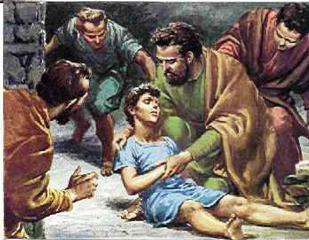 However, we recall the time Paul preached with a slight interruption to restore life to a boy who had fallen out a window when overcome by sleep. Perhaps ever since that event, church windows have been designed to prevent similar occurrences.
A helpful division of Hebrews has been suggested by Father John F. McConnell M.M. In our updated presentation we present only the main divisions without the five subdivisions in each of the first three divisions.
The Living Way and the Living word: 1: 1-4:13
The Living Way and the Life of Worship: 4:14-10:31
The Living Way and the Life of Faith: 10:32-13-17
Conclusion: 13:18-25

No Comments