



A Guide to Reading the Bible #11 – Epistles to the Thessalonians
Thessalonica was in Paul’s day, as today, the second city of Greece. In the north, it is a port on the Aegean Sea.
 St. Paul established the Church in Thessalonica around the year 50 A.D. on his second missionary journey. His companions were Silas, a leader in the Jerusalem Church who had come to Antioch, and Timothy, who had been recruited in Lystra and who was to become Paul’s favorite disciple and main collaborator.
The trio arrived from Philippi when the troubles in that city made it advisable to move on. Paul set up his headquarters in the home of a Jew named Jason. This house became the first church in Thessalonica.
The story of St. Paul’s stay in Thessalonica is told at the beginning of Chapter 17 in the Acts of the Apostles.
“Now when they had passed through Amphipolos and Apollonia, they came to Thessalonica where there was a synagogue of the Jews. And Paul went in, as was his custom, and for three weeks he argued with them from the scriptures, explaining and proving that it was necessary for Christ to suffer and to rise from the dead, and saying, “This Jesus, whom I proclaim to you, is the Christ. And some of them were persuaded and joined Paul and Silas; as did a great many of the devout Greeks and a few of the devout women. But the Jews were jealous, and taking some of the wicked fellows of the rabble, they gathered a crowd, set the city in an uproar, and attacked the house of Jason, seeking to bring them out to the people.”
The outcome of this disturbance was a hasty departure from the city during the night.
Paul’s two letters to the Thessalonians are the first two of his writings. Rather brief, especially the second, they written a few months apart in Corinth in the year 51 or 52. Paul had come to Corinth from Thessalonica after establishing the Church along the way in Beroea, and failing to establish it in Athens. Both Silas and Timothy joined him in Corinth. Timothy had returned to Thessalonica from Athens at Paul’s request to find out if the Christians had remained faithful despite the persecution that continued after Paul’s departure.
Timothy’s report was very favorable. So St. Paul wrote his first letter to the Thessalonians with joy in his heart at their constancy. He also answered questions presented to him through Timothy. Paul uses the occasion to defend himself from the enemies of that church who put an evil interpretation on his departure and absence. He recalls the teaching of the Gospel on sexuality and makes particular recommendations on the exercise of fraternal charity. Paul also instructs them on the second coming of Christ and its relation to Christians who have already died.
In Paul’s second letter, written a few months later and probably at Corinth, he makes further practical recommendations and gives more instruction on the second coming of Christ. What Paul meant by the various “signs” of this coming of Christ is still a puzzle to us today. However, it was no doubt clear to the first readers of this letter in Thessalonica.
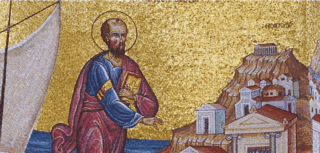 The importance of these two epistles lies in the initial insight they give us into Paul’s pastoral method and what they reveal of Paul’s personality. They are not among his major epistles, Corinthians, Galatians, and Romans, in which important doctrinal matters are developed. But these later epistles developed the fundamentals laid down in Thessalonians – emphasis on faith, hope, and charity, and on intimate union between Christ and the Christian.
These epistles are the first record of the religious convictions of one of the greatest teachers in the formative age of the Church.
In conclusion, we wish to quote a passage that provides as good a rule of life for us today as it did for the persecuted Christians in Thessalonica. “Be happy at all times, pray constantly; and for all things give thanks to God, because this is what God expects you to do in Christ Jesus” (1 Thess. 5:16-18).

No Comments