



A Guide to Reading the Bible #8 – Epistles to the Corinthians

As a rule Paul went to population centres to establish the Christian faith. In Greece he went to Athens where he met such ridicule that he gave uo the attempr. Discouraged and disheartened, he set out for Corinth – a most unlikely prospect.
The city of Corinth had a unique position in the ancient world of the Mediterranean. It controlled the narrow isthmus of Corinth which joined mainland Greece to the peninsula known as he Peloponneus. Corinth had two sea ports – one on the Gulf of Aegina and one on the Gulf of Corinth. To avoid the long and dangerous voyage around the Peloponnesus, cargos were unloaded at one of Corinth’s ports, transported across the peninsula and loaded on another ship at the other port. Of curse, Corinth collected tariffs. Corinth was wealthy, one of the most cosmopolitan cities of the ancient world. Its population of about 600.000 included 400,000 slaves and it was notorious for every kind of vice.
Paul arrived in Corinth towards the end of the year 50 and he stayed until the middle of 52. He succeeded in Corinth where he had failed in Athens. Although some of the wealthy joined the Christian community, his converts were mainly from the lower classes. They were fervent, eager, blessed with the gifts of the Holy Spirit. But it was not easy to be a Christian in this notorious centre of immorality. Trouble broke out after Paul left. 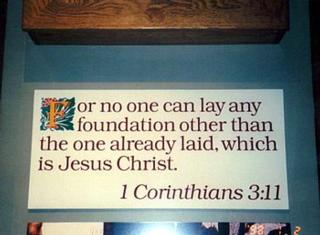
The letters known as First and Second Corinthians were written to solve the problems caused by the evil environment of Corinth. Paul wrote the first letter at Ephesus shortly before Easter in the year 57. He wrote the second letter from Macedonia jn the fall of 57. There had been an earlier letter written from Ephesus which Paul refers to in 1 Cor 5:9-13 but it has not survived.
First Corinthians is concerned primarily with answering questions put to Paul by a delegation sent from Corinth. Paul had other reports about the trouble from Apollos and from Chloe’s household.
The letter can be divided as follows:
1. Disorder in the Church, 1:10-6:20.
2. Answers to questions, 7:1-11:1.
3. Regulations for liturgical assemblies, 11:2-14-40.
4. Resurrection of the dead, 15:1-58.
5. Conclusion, 16:1-24.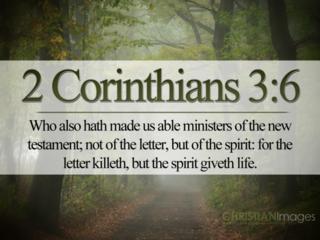
Shortly after Paul wrote First Corinthians, some sort of crisis developed in Corinth and Paul had to make a brief visit. He promised to make a longer visit but instead sent a delegate in his name whose authority was flouted. Paul then wrote another letter, Second Corinthians, which was severe but settled the problem in Corinth.
The letter can be divided as follows:
1. Justification of Paul’s actions, 1:15-7:16.
2. Collection for Church in Jerusalem, 8:1-9:15.
3. Paul’s defence of his role as an apostle, 10:1-13:10.
4. Conclusion, 13:11-13.
Corinth presented Paul with one of the greatest challenges of his career – a showdown on his authority as an apostle. Paul won out.
 In these two letters we see Paul’s religious genius at work. He is able to turn cases of conscience or liturgical instructions into a vehicle for the profound doctrines of Christian liberty, the sanctification of the body, the supremacy of love, union with Christ. The controversy led Paul to a presentation of how the life we lead here and now is already a life of union between Christ and His followers. This union is achieved by faith which is the only way to know Him.
First Corinthians especially, gives us a clearer picture of life in an early Christian community than any of the other epistles of the New Testament. If we may be permitted a small observation, Christian communities even in those days were not all sweetness and light.

No Comments