



Someone told me it’s all happening at the Zoo. I do believe it. I do believe it’s true. – Part 1
Winnipeg’s Assiniboine Zoo is a place to venture into the ancient past and the distant past. Two of the most endangered large cat species, Asiatic twin male lions, Bhanu and Kamal, have been in the Zoo since 2012. Yesterday I startled Bhanu napping leaning against the fence. He snorted at me with aggressive annoyance. I wondered did their ancestors miraculously spare Daniel centuries and centuries ago? 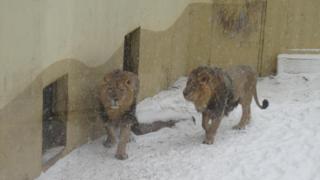
Not too far distance is the corral of the rare Przewalski’s Horses, equus caballus przewalskii, or as the volunteers at the Zoo call them, “p” horses, the last of the “true” wild horses and only surviving ancestors of the domestic horses. Also from the Asian grasslands, these were brought back from extinction in the wild by a successful breeding program from only 14 animals! Apparently they originated in Mongolia. I pondered how they came to be there and wonder if they had roots in biblical times.
‘Horses’ apparently are mentioned 153 times in those sacred books and someone counted up 56 verses about horses. Most of them reference horses’ power and usefulness in wars and battles.
Putting Job “in his place”, God asks (39:19-25), “ Do you give the horse his might? Do you clothe his neck with a mane? Do you make him leap like the locust? His majestic snorting is terrifying. He paws in the valley and exults in his strength; he goes out to meet the weapons. He laughs at fear and is not dismayed; he does not turn back from the sword.”
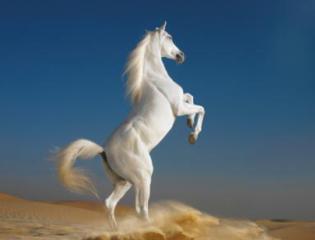 The prophet Isaiah notes too that horses "do not stumble in the desert" (63:13) and have hooves that seem “as sharp as flint” (5:28). But The Book of Proverbs (21:31) wisely warns: “The horse is made ready for the day of battle, but the victory belongs to the Lord” and Psalm 20:7 concurs, “Some trust in chariots and some in horses, but we trust in the name of the Lord our God”.
It seems that the destruction of the horses, chariots and riders of Pharaoh who had the temerity to attack Moses and God’s people (Exodus 15) illustrates the benefits of trusting in God, not horses, particularly celebrated in the famous joyous song of triumph: “I will sing to the Lord, for he has triumphed gloriously; the horse and his rider he has thrown into the sea.”
In King Solomon’s time it seems the horse is a symbol of kingship and power. 2 Chronicles 9:25 reports that he had 4,000 stalls and 12,000 horses imported from Egypt and from all lands. The number is inflated to 40,000 stalls of horses in 1 Kings 4:26! Curiously this supposed wise (and amorous?) king, in his famous Song of Songs declares, "I compare you, my love, to a mare among Pharaoh's chariots" (1:9)!!?
Horses appear in apocalyptic passages with celestial power and might. 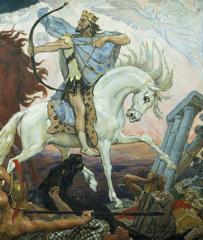 The Rider in the Book of Revelation (19:11) called “Faithful and True who judges and wages war” sits on a white horse.
The four chariots in Zechariah’s vision (6: 6-7) are drawn by red, black, white, and dappled horses, “all of them strong, who go out to the four winds of heaven, after presenting themselves before the Lord of all the earth."
And in 2 Kings 2:11 horses of fire take Elijah into the heavens in a whirlwind. Who does not cringe to read about the pale horse whose rider is Death?!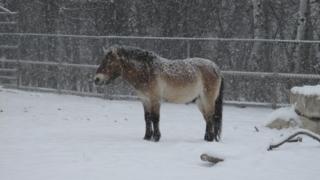
It’s hard to imagine these two rare yet nameless “p” horses quietly munching hay in their zoo enclosure and rubbing their bodies against the wooden posts could be ancestors of these celebrated steeds!

No Comments