



A Guide to Reading the Bible #4 – The Gospel of St. Luke

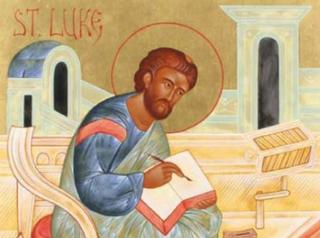
The poet Dante described Luke as the faithful recorder of Christ’s loving-kindness. Luke wrote both the third Gospel and the Acts of the Apostles. He was St. Paul’s companion on many of his fatiguing and dangerous travels and was at his side during his imprisonment at Caesarea and at Rome. St. Paul in his second letter to Timothy (4:11) identified his faithful companion as “Luke, our most dear physician.”
Luke was born of Greek parents in Syria and was baptised a Christian while still a very young man. Before meeting St. Paul, Luke was educated in the Greek classics and specialized in medicine. His sympathy for human weakness and suffering reveals the heart of a physician.
At Antioch he not only received the Faith but also learned cetain details of Christ’s life from Manahan, a boyhood friend of Herod Antipas, and from Johanna, the wife of Chuza, Herod’s steward. At Ephesus he was in touch with St. John and perhaps with Mary, the mother of Jesus. During Paul’s captivity in Caesarea, Luke had time to question the deacon Philip who evangelized Samaria. He also talked to the women who used to provide for Jesus and His apostles during their travels.
As a careful student, he made abundant use of written collections—the Gospel of Mark, especially. He relied, too, on the written collection of Jesus’ sayings and deeds. There were other written sources available to Luke while writing his Gospel – the Infancy Narrative, for instance. St. Luke in the beginning of his Gospel described his work – “following up all things carefully from the first”(1:3).
Scripture scholars describe Luke’s Gospel as a perfect work showing delicacy, care, literary genius, exact information – the work of a craftsman whose concentration never slackened. Of it St. Jerome wrote that “as often as the book of Luke the physician is read in the Church, so often does his medicine flow” to refresh the Christian heart.
St. Luke wrote in Greek for Gentile converts and so he stressed what was most beneficial for that audience. His work is best described as a Gospel of mercy and universal salvation. He is anxious to stress His Master’s love of sinners, and to record His acts of forgiveness, and to contrast His tenderness for the lowly and the poor with His severity towards the proud and those who abuse their wealth. Repentance is necessary and abdication of self along with complete detachment. There must be prayer as exemplified in Jesus Himself. His Gospel gives the Holy Spirit the prominence we find in the writings of St. Paul and in the Acts of the Apostles. It is also a Gospel of joy and praise – the angels sing in the beginning and the apostles at the end are in the temple praising God, their hearts filled with joy.
Luke’s Gospel maintains the same general pattern as those of Matthew and Mark: John the Baptist, the Galilean ministry, the journey to Jerusalem, the Holy City. But Luke makes Jerusalem the symbol of fulfillment of all God’s plan for salvation. The journey to Jerusalem was a spiritual pilgrimage to the cross and the resurrection built on the destruction of the leaders of Judaism because they had destroyed the true spiritual significance of the Holy City.

No Comments