



Pope Francis’ Starting Point: The Other has a Good Will
Pope Francis’ recent visit to the U.S. has been one of bridge-building across a divided political landscape. 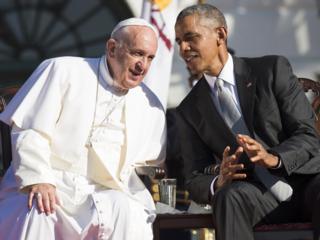 The Holy Father’s message focused on issues that gather people together in service of a common good; issues like helping refugees and immigrants, protecting the environment, and promoting the rights of the poor. He chose to emphasize encounter and dialogue. This is not surprising given that he is a Jesuit and the Jesuits train for loving dialogue with others who are from different cultures and contexts. A key model for such dialogue is found in the writings of the Jesuits’ founder, St. Ignatius Loyola.
Ignatius lived during the 17th century, in a world battered by religious and political strife. In the here and now, Pope Francis voices sorrow and condemnation for religiously motivated violence in our world. Ignatius’ also sorrowed. He witnessed severe violence arising due to schisms of Catholic and Protestant doctrine, politics, and nationality. Many writers of this time fell into a siege mentality, writing vitriolic condemnations of perceived enemies and errors. Without giving up his own principles, Ignatius sought a different way to approach the other. A way of self-offering and friendship.
The “other” is someone on the margins, someone who has a different life and experience. Ignatius’ starting point for dialogue is that the other has a good will. He writes about this in his Spiritual Exercises.
Ignatius’ Spiritual Exercises are writings for a very specific context. He is writing instructions for a guide or “director” who helps persons master methods of prayer. A spiritual director listens carefully to the other’s experience, offering feedback and guidance. In his instructions, Ignatius offers a starting point for dialogue which he titles the Presupposition.
 “…let it be presupposed that every good [person] ought to be more ready to save his neighbor's proposition than to condemn it. If he cannot save it, let him inquire how he means it; and if he means it badly, let him correct him with charity. If that is not enough, let him seek all the suitable means to bring him to mean it well.” -St. Ignatius, Spiritual Exercises. Elder Mullan, trans. <Sacred-Texts.com>
It is remarkable that in a Europe on fire with suspicion and polarization, Ignatius instructs both teachers and learners to try to save what the other is saying. When there is a dispute it is vital not to throw up walls, shutting down dialogue. It helps to assume, to presuppose, that the other person has a good will and is trying to convey a good truth.
Francis did not appear before others with a list of condemnations but a list of hopes. He hopes for the realization of dreams not merely for a few but for all – especially those most marginalized. He makes no compromises in his opposition to violence, exploitation, and environmental degradation. However, the Pope does not make these problems the fault solely of some caricatured enemy. He identifies these as shared problems and calls for sharing in the work of finding solutions.
“…if we want security, let us give security; if we want life, let us give life; if we want opportunities, let us provide opportunities” -Pope Francis, Washington Address. <Libreria Editrice Vaticana> 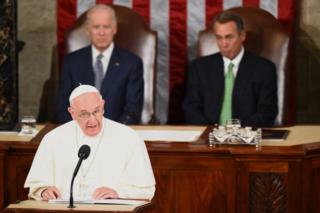
Ignatius’ presupposition is a very basic attitude that shapes Pope Francis’ approach and can shape our daily lives. Francis and Ignatius encourage us to examine ourselves. I am called to watch for the moment when I start to get angry, when I start to see the other not as a person with a perspective but an enemy with a threat. At such moments I need courage in order to lower my defenses and to reach out, to ask the other what they mean and what their experience is. Finally I am called to share responsibility with them for solving problems.
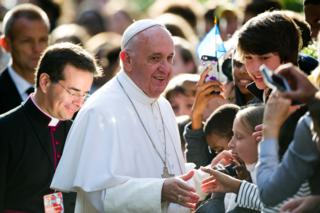 If you reflect on your life, who are the enemies? What are the disagreements that make you grit your teeth and rehearse arguments against imagined opponents? These are the very places to soften the heart, to build bridges, to look especially for common ground and shared values. These are the times to assume that the good in the other person is there waiting to be found.
We will not finally be at peace when we are all one and of one mind. God has blessed us with a world of immense diversity. Peace will come from a hard struggle to learn and grow from our differences. Francis’ approach provides us with a good starting point for beginning this work.

No Comments