



Saint Jean de Brébeuf
We celebrated, in 2011, the 400th anniversary of the arrival of the first Jesuits in Canada, at Cape Breton, N.S. It is impossible to look at the history of Canada without considering the life of Saint Jean de Brébeuf, the seventeenth century missionary and pioneer. Brébeuf was born in Normandy, France on 25 March 1593 and entered the Jesuits at the age of 24. In 1625, a few years after being ordained to the priesthood, he sailed for Quebec. It is ironic that his formation was shortened due to poor health, since “the giant of the Huron missions” would be recognized as the most robust of the black robes in the region of Huronia.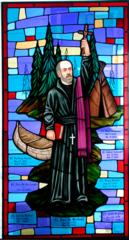
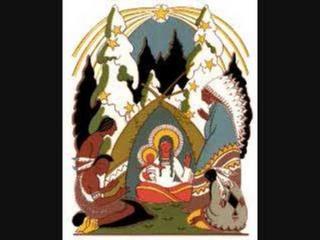
Brébeuf’s first missionary activity in New France was with the Algonquians. This helped orient him to aboriginal ways. After that experience, he lived with the Huron (the Ouendat) and learned their customs and language, becoming expert enough to write a dictionary of the Huron language. He also wrote the Huron Carol, a Christmas carol, a modified form of which is still sung today. Success at evangelization took tremendous patience. Brébeuf saw gradual results from his efforts at conversion and baptism. It was only toward the end of his life that he could use the word success, if we measure his impact in numbers.
 Jean de Brébeuf possessed qualities that we associate with heroic personalities. He was charismatic in his influence on others – the Hurons and the Jesuits with whom he worked. For a while, he was the superior of the Huron mission. In him the other Jesuits found a mentor and from him they learned the ways of the Huron people, instruction in practical skills and the Huron language. He was recognized for excellent judgement and for a discriminating observation of the people and land. Influence also came from his physical strength and gentle disposition. He paddled all day on long canoe voyages. Several times, he made the treacherous 800 mile canoe trek from Quebec to the Huron territory, becoming one of the principal chroniclers of this route to the West.
He willingly carried the heaviest loads on the many portages. “I was at times so weary that my body could do no more. But my soul was filled with great happiness as I realized that I was suffering this for God.” The Huron name for Father Brébeuf was Échon, a word that means either “healing tree” or “he who bears the heavy load,” both meanings evoking qualities that Brébeuf shared with the Huron people. “The Apostle of the Hurons” had entered the culture, manners, and customs of the people in a way that no white person before him had.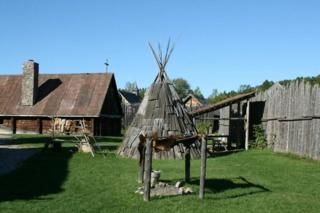
By the 1640s, the Iroquois were at war with the Hurons. In March 1649, 1200 well-armed Iroquois captured two villages and took as prisoners Brébeuf and a fellow Jesuit, Gabriel Lalement. They were taken to the village of St. Ignace, fastened to stakes, and tortured to death in a brutal manner, Brébeuf being martyred on March 16 and his companion the next day. He was nearly 56 years old. He was canonized in 1930 along with the seven other Jesuit Martyrs of North America. They are celebrated on September 26 in Canada and October 19 in the U.S.A.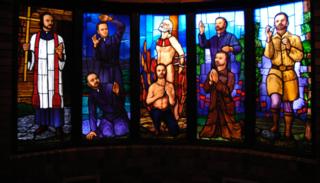
Even in death, Brébeuf had a charismatic influence on people: the Iroquois torturers cut out his heart and ate it in the hope of gaining the courage of this powerful man. The Huron mission died with Brébeuf, he who had begun it. This missionary was an apostle, a brave adventurer, a skilled writer, a careful ethnologist, a man of vision, and, finally, a martyr.
It is a basic human need to have heroes, people who inspire and are bigger than life. St. Jean de Brébeuf is one of those figures. He is a witness to gentleness and strength, humility and courage, a love of the cross of Christ and the effects of His resurrection. He was a quiet and effective leader. We find many schools, summer camps, and parishes named for him. May he continue to be a role model for young people and for the Canadian Jesuits as they move into their fifth century of presence in this country!
No Comments