



Canadian Jesuits: the Nouns of a Nation

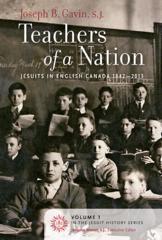
In this piece Kevin Burns writes about his conversation with Jacques Monet SJ, the executive editor of a new two-volume history published by Novalis: “Teachers of a Nation” and “Builders of Nation” both subtitled “Jesuits in English Canada 1842 – 2013” and launched at Regis College two weeks ago in Toronto.
The larger-than-life-historian Donald Creighton once said that history is “the record of an encounter between character and circumstances” (Toward the Discovery of Canada). The evolution of these two new volumes on Canadian Jesuit history illustrate Creighton’s proposition in a very particular way.
First, “character.” 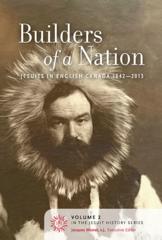
As Director of the Institute of Jesuit Studies, Monet oversaw the publication of a set of Jesuit biographies identifying the lives of English-speaking Canadian Jesuits who worked between 1842 and 1987 (in volume I) and those who served between 1988 and 2006 (in volume II.)
And now “circumstances.”
With such an extensive cast of characters firmly established, it’s not surprising that in this new collection of essays Monet shifts the editorial focus from biography to “circumstances” – as in themes. These two volumes are organized according to themes including education, First Nations, social justice, and communication.
“It began,” explains Monet, “when we realised we had a lot of material that was not covered in the biographies because biographies are specifically about one person. Since we had all this material we might as well write a history that would provide the context of a lot of the work of the people that were in the dictionary.”
To hear more of this explanation click on Play below:
These two volumes are the result of extensive team work, a team comprising Joseph Gavin SJ, John Meehan SJ, Michael Knox SJ, John D. O’Brien SJ, Winston Rye SJ, Michael Stogre SJ, and Peter Baltutis. In his role as team leader, Monet thoroughly enjoyed the experience of collaboration. “We worked collaboratively very finely and it worked beautifully. We had a lot of pleasure discussing things and who would write what, what angle to take because people had different views and everything. And it worked very well.”
To hear more of this explanation click on Play below:
 History, as the theologian Hans Urs von Balthasar cautions, is rarely fixed. “[O]ne cannot say that every life, every age, has its own self-contained meaning. The significance of past ages and individual destinies is not irrevocably fixed, and they remain accessible to us; their meaning can always be newly defined and be transformed with the passage of time.” (A Theology of History)
In our conversation Monet reminds me that the historian’s role is not speculation. The historian “has to go with the available material” and history is continually re-written as more source material surfaces.
The historian’s job is to focus on the record, wherever it is found. In 1975, Northrop Frye suggested that such a fascination with the historical or documentary record is something quintessentially Canadian. The Canadian consciousness is, he said, “peculiarly adapted to preserving its own heritage, not like a miser guarding his hoard…but like one who understands that all coherent action, as well as all moral integrity, depends on the continuity of the present with the past.” (Address to the Royal Society of Canada)
That continuity also interests Monet. The characters in and the circumstances of the events in the pages of these two volumes remind readers today that the Catholic world was and remains a very human place with all manner of confrontations, conflicts, resolutions, and unfinished business. Parishes are built up, schools and colleges are established, people move, and plans change. When I tell Monet how messy some of the situations described in the two volumes appear, he smiles. “Well, everything in life has its own panorama of issues that you have to decide on. With any decision you have to take in a number of issues. The interesting thing about history is finding out who was involved in this and who was involved in that, how they ended up agreeing or disagreeing, or cooperating or abandoning the project. Isn’t it like that every day of our lives?” 
That sense of discovery for a purpose echoes the belief that history is something we can learn from, as articulated by the American documentary filmmaker, Ken Burns (no relation). He feels that history is “our most important teacher.” Canada’s Desmond Morton is more circumspect. In 1993, Morton wrote that history is not a teacher so much as “another word for experience. It is neither a weapon nor a user’s manual. At best, it encourages patience and a long view.” (Divided Loyalties? Divided Country?)
Monet is certainly taking a long view with this work. A third volume is already in preparation and will be released next year. Joining “Teacher” and “builder” will be the noun: “Conscience” as in “Conscience of a Nation.” And, Monet suggests, there is the possibility of a fourth volume after that.
For a description of the proposed third volume, click the Play button below.

No Comments