



The Community Life of One Jesuit Bishop

For most of the first thirty-four years of my life as a Jesuit, I lived in communities of seven to more than one hundred members. These communities were in places as diverse as Guelph, New York, Montreal, Toronto, Halifax, Rome and Regina.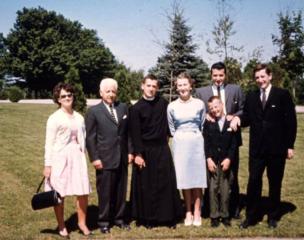
I cherished the priests, brothers and scholastics that made up these communities for the support and challenge they gave me as a Jesuit and a priest. We celebrated Mass and prayed together. We studied, worked and argued together. We laughed often and cried sometimes. We asked pardon of each other. We played hockey and bridge with a passion. We generally enjoyed each other’s company. Community life is one of the blessings of being a Jesuit.
I lived outside a Jesuit community a few times early in my priesthood. From 1975 to 1979, I lived with the diocesan seminarians in Halifax in whose formation I was closely involved in my first years as a teacher. From 1994 to 1995, I spent my sabbatical year as a visiting professor with the Dominicans at the École biblique et archéologique française in Jerusalem. During that stay, I was named a bishop. In each of these times, I was closely associated with the local Jesuit community, which I visited regularly.
Yet for a Jesuit, community life is not an absolute. Community life is primarily for the mission. Jesuits share communities in locations around the world for the good that needs to be done for God’s holy people. The Jesuit has to be ready to be sent to the frontiers, to what Pope Francis calls the peripheries, whenever there is a need that must be met in this way. We say, “A Jesuit carries his community in his heart.”
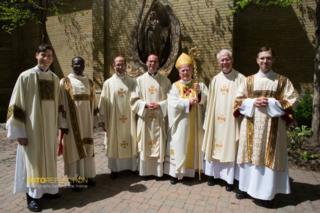 This has been my experience in the years since I accepted the call of Pope John Paul II to serve the Lord and his Church as a successor to the apostles. I served first as an auxiliary bishop in Toronto (1995–98) and afterwards as archbishop in Halifax (1998–2007) and in Ottawa (beginning in 2007).
While living by myself in a small town-house in Mississauga upon my nomination, I was able to maintain contact with my former Jesuit community at Toronto’s Regis College. I commandeered the guest room each week and visited there on my day off. I shared a Mass, meals, and chats. During those first three years as a bishop, I frequently dropped in on other Jesuit communities in the Toronto area.
When I moved to Halifax, I lived by myself as a tenant in the former Archbishop’s residence that the city had bought, until I could move to a smaller house. I did not think it wise to invite a priest to live with me until I had familiarized myself with the diocese and could be home to share life with him. Just as I was about to do so, the Holy See asked me to serve as Apostolic Administrator of the Yarmouth Diocese, which frequently kept me on the road.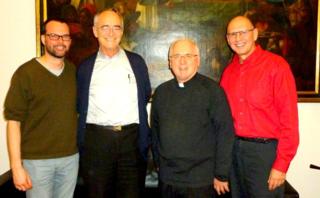
I connected with the Halifax Jesuits on Sundays, when the diaspora brethren in parishes outside the city came for communal reflection, conversation and dinner. I knew many of them already from my first stint there. The Jesuits in Halifax showed me the same welcome I had experienced living in Toronto or Rome or in visits from Addis Ababa to Warsaw.
I have discovered that the brethren are open to sharing their inner lives and beings with a brother religious on short acquaintance. I especially noticed this when I spent a week in Athens instead of the customary day or two that visitors usually do. By the time I left, I had heard almost everyone’s vocational story, his joys, and his sorrows! No wonder Jesuits like to describe themselves as “friends in the Lord.”
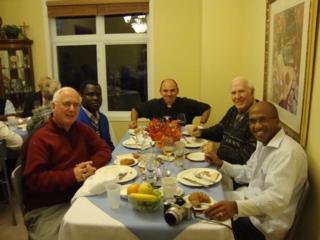 Now, since my move to Ottawa, I share a large residence with several neighbours. They are eight priests: four are my close co-workers in the governance of the Archdiocese, a graduate student, a scripture teacher, and two retired priests (who keep busy with pastoral ministry). We pray together at Mass, collaborate at the cathedral, frequently receive visitors, and share our lives. It is a happy household.
In Genesis 2.18, God said, “it is not good for the man to be alone.” God gave Eve to Adam to be a helpmate, to establish communion, and to bring forth new life for the world.
In creating the new family of the Kingdom, Jesus chose to live as a celibate to symbolize the singular focus of a life dedicated to God. He called those whom he wanted to be with him and then to send them out on mission (Mark 3.13–14). He created the apostolic body and founded a pattern of communal life that religious and priests and bishops have replicated in various ways since then.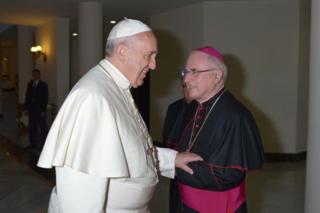
I am grateful for the brotherhood I have enjoyed and look forward to the ways in which community life will continue to bless the Body of Christ in the days and years to come.

No Comments