



Canadian Jesuit identity: Eloquent Images New and Old

In late July a meeting of Canadian Jesuits and their non-Jesuit partners took place in Pickering. The purpose was to continue a process of apostolic discernment meant to answer the question: What priorities does God want us to adopt for our apostolic action? With our limited resources, what should we be doing? In our conversations we used the Ignatian tools of communal apostolic discernment. In this form of discernment the group is often invited to give itself a name, a name which helps it express its identity. In our meeting this invitation bore much fruit, because we went beyond names to images.
With the exception of some nicknames, in our own cultural space the image underlying a name is long forgotten: when we say John we do not automatically image a person receiving God’s favour, or when we say Smith a muscled man working at an anvil. By contrast, in many cultures the image underlying a name is easily accessible. For instance Jewish biblical names often contain the name of God (“el” at the end or “iah” in some form at the beginning or at the end) and a verb that is evocative, e.g. Jo-seph, Jo-shua, Gabri-el, Isra-el. And biblical names are given – sometimes supplanting an earlier name – because of their evocative power: for example, “you are Peter and on this rock I will build my church”.
 Coming up with a name is not the essential point in this exercise. What counts is allowing images underlying the quest for a name to emerge. Such images might not directly divulge to the group what its mission is, though it may offer clues, but it will help it articulate a felt sense of how it finds itself as it faces its mission and assesses its willingness to carry it out. A felt sense: a heart-knowledge of what the Lord is doing within each member of the group and with the group as a whole rather than an application to our situation of this or that feel-good saying gleaned from a book or article or even a decree of one of our congregations.
A number of images surfaced in our meeting. We played with them, explored their ramifications, shared them with the whole group. Strikingly, a number of them brought us to a renewed and deeper consciousness that we are pilgrims on a journey, companions, “in it together.” One of these images was that of a canoe, part of the mythical background of our own country and of our own Jesuit origins in Canada, beginning with the first nations for whom it was a favourite means of transportation, but soon adopted by the newcomers, including the Jesuit missionaries who circulated between Quebec and their outpost in Huronia. More recently, on the occasion of the Canadian centenary celebrations, this trip was re-enacted by Jesuits of both Canadian provinces. So this image spoke loudly to those assembled, not to the exclusion of other images, but as a powerful and evocative symbol of what we are about as Canadian Jesuits.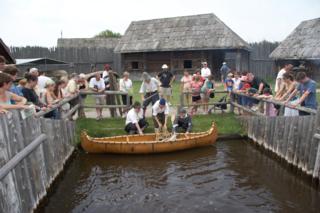
What deeply felt awarenesses did this image bring to the surface for us? Let us mention a few of them:
A canoe is light-weight, pared down to the bare essentials because trips often require difficult portaging. In an earlier stage of our existence, the image of canoe would not have easily emerged. We were well endowed (even at times encumbered) with institutional apostolates, especially in the educational sector. Most of them we have given up. We used to be more protective of the institutions in which we served – and this came out in earlier attempts at apostolic discernment – but now we are freer to go where we are needed, serving the Lord there, and then moving on.
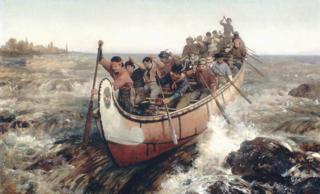 Those who paddle a canoe must pull together, creating a rhythm that enables the canoe to move more efficiently. We are in the same canoe, and we have no choice but to be in solidarity with each other as we move forward, constantly sensitive to the movements and inclinations of those around us. As our numbers diminish, this has become essential. We cannot afford to have our movements cancel each other out and hinder the movement of the canoe. Over the years, beginning with the 1980's we are much more comfortable with spiritual conversation in which we not only speak our minds but also listen in depth. We have received the gift of greater sensitivity, greater readiness to pull together as we face new challenges.
The canoe is not a splashy vehicle that draws attention to itself. Ideally the paddles slip in quietly, do their work, and slip out just as quietly. A canoe might easily go unnoticed and all of a sudden it is there at your side. The point of our ministry is not to draw attention to ourselves but to get the job done, whatever it is that the Lord wants us to do. Of course we need to make our presence felt, but not in a splashy way in which we deliberately show off our skills and competence. We do not need to be acknowledged as leaders. We are ready to participate in enterprises led by others; we pass unnoticed, but still have the impact the Lord wants us to have.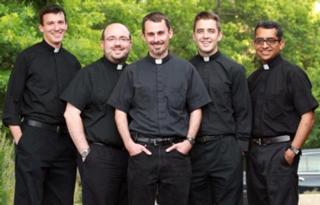
This last point brings to mind another set of images that emerged in our conversation, which were expressed with the words “catalyst” and “leaven”. Our role is to enliven, focus, facilitate, help carry forward the energy of many others. The leaven works silently, but in the end it enables the ingredients which were mixed together to achieve nutritious and enjoyable bread, with just the right texture.
Why is it that at this stage in our journey as Canadian Jesuits we are willing to take such images to heart? The pioneering efforts of the 1980's to encourage us to speak together in discernment like Ignatius and his companions set us in a right direction and gradually we learnt new ways of being and talking together. But external events also played a crucial role. As I mentioned, beginning with the 60's we let go of many prestigious institutions we had taken on. Our place as part of the cultural elite of our society gradually diminished, maybe more rapidly in French Canada than in English Canada.
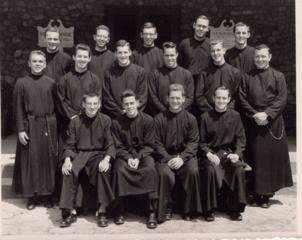 Before the 60's we received large classes of novices, many of whom continue to be a blessing to our community and our ministries, but many of whom fell by the wayside. Of these some were “sociological” vocations, men who caught up in the assumption that by entering the Jesuits they could play a significant and recognized role within society as a whole. This expectation was shattered. The “révolution tranquille” burst upon the scene in Quebec, and the resulting marginalization and diminishment of religious communities has been dramatic. The rest of Canada has been moving in the same direction.
Since the 70's notably fewer men entered the Jesuits, but more and more of them have been entering with their eyes open to the challenges of the contemporary Society of Jesus, already divested of many of its institutions, humiliated through the sexual abuse crisis, and far from the pinancle of influence and power in our society. Indeed we are called once again to be the least society which Ignatius wanted us to be, and this attracts rather than repels those called to join us. That, together with the maturation of our newer formation patterns in the wake of Vatican II, meant that from the year 2000 on there was a marked diminution of departures in our province.[1]
The images of canoe and catalyst emerged in our meeting not from a superficial place where easy slogans reside but from the depths where a collective conversion has been taking place. We have fewer younger companions to continue our work than in the 40's and 50's, but the ones the Lord has given us are ready to offer solid leadership for this new era, and they are surrounded and supported by many enthusiastic collaborators, ready to paddle beside us not to find our way back to former glory but to move forward towards the places where the Lord wants us to be. While we will encounter resistance and obstacles, still an image to which many at our meeting reacted favourably was that of the canoe taking advantage of an underlying current carrying it forward. That current is the grace of God and the energy of the Spirit enveloping our efforts and consolidating the work of our hands.
+++++++++++++++++++++++++
[1]When I was socius in 2001 I did an actuarial study which predicted that there would be 139 members in the English Canada province in 2011. The actual number was 159.Where did I go wrong? A few more novices entered than the earlier rate suggested, and there were a few less deaths. But by far the main factor was that I used the departure rate from 1980 to 2000 in my calculation of departures from 2001 to 2011: in reality departures in that decade were far less numerous.

No Comments