



Some Thoughts on Praying (5)
The Buddhists of Tibet use prayer wheels which consist of a wheel, a cylinder, or vertical drum containing written prayers. Each revolution of the wheel represents one repetition of a prayer. The mechanical action seems to replace the need for mental attention being given to the prayer.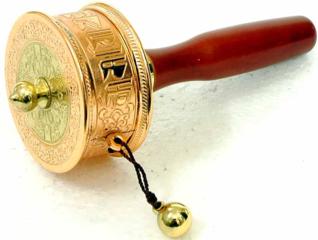
Christian prayer is not to be one of rote or mechanical. The minimum requirement for a Christian is attention to the words because the purpose of praying is for a deeper relationship with God. There can be a growth in this relationship if we pursue it diligently. God is leading us and teaching us and uniting Himself with us. The topic of relationship with God is vast indeed because it leads into the nature of God Himself who is infinite.
Besides attending to each word as we recite a prayer, we can reflect on the meaning of each word. In doing so, we are progressing in a very fundamental way into the area of mental prayer.
One expert in praying, St. Ignatius of Loyola, the founder of the Jesuits, long ago recorded his own experiences about praying in his classic “Spiritual Exercises.” In that brief book which is more a handbook or manual to guide us in developing the spiritual life, similar to a handbook on developing our physical well being by various physical exercises. In that book, he gives directions for the method of praying in which we reflect on each word of a prayer.
 He gives directions on other methods of praying, too. but for now we are considering what St. Ignatius suggested to do so that this method might prove to be helpful. Briefly, before entering on the prayer, I recollect myself for a while, and either seated or walking up and down, as may seem better, I will consider the prayer I have chosen, the Our Father, for example, and why I chose it.
Then I ask God our Lord for grace to understand more deeply the meaning of the Our Father and how it applies to my living.
One may kneel or sit, as may be better suited to one’s disposition and is more conducive to devotion. Keep the eyes fixed closed or fixed in one position without permitting them to roam. Then say, “Father,” and continue meditating upon this word as long as you find various meanings, comparisons, relish, and consolation in the consideration of it. The same method should be followed with each word of the Our Father, or of any other prayer which one wishes to use for this method.
St. Ignatius then proposes some rules about his method of praying and a couple of notes.
Rule 1. One should continue for the period of time determined beforehand in the way described going through the whole Our Father prayer. When finished, say some familiar prayers like the Hail Mary, the Creed, Soul of Christ, Hail Holy Queen, vocally or mentally, in the usual way.
Rule II. If one is contemplating, for example on the Our Father, and just one or two words provide abundant matter for thought and much relish and consolation, then one should not be anxious to go on to further words even though the whole of the prayer session be taken up with those initial words. When the time one allotted for praying is up then recite the rest of the particular prayer in the usual way.
Rule III. If the prayer session was taken up with only a few words of the prayer, then when beginning on another occasion, recite those words in the ordinary way and commence to contemplate on the words that follow.
Note I. After one or more days, upon completing the Our Father, then use the Hail Mary for prayer in the same way, then other forms of prayer, so that for some time one is always engaged with a familiar prayer formula.
Note II. At the end of prayer, one should turn to the person to whom the prayer is directed, and ask for the virtues which one feels are needed the most. This type of prayer is known as colloquy and it is made by speaking exactly as one friend to another. Exchanges between friends can involve asking for a favor, apologizing for a misdeed, confiding one’s plans and aspirations, seeking advice for a course of action. So, too, can be the content of colloquys as one concludes a prayer.
The rules in any handbook can seem to be intricate and involved. Often it takes much longer to explain how to do something than to carry out the instructions. The same can apply to the rules for praying. What St. Ignatius outlines is quite simple to do after an initial attempt to follow what he suggests. It is not mechanical like a prayer wheel as evidenced by the basic principle of pausing and staying with what nourishes. Try it with trust that God is waiting to help you to be more intimate with Him.

No Comments