



Kino? Chino? Chini?

I’ve been thinking a lot about saint in the past few weeks in light of the recent spectacle of two live popes sainting two dead popes. Getting “your person” through the system is the name of the game and the stakes are high. I stumbled on to one of the people in the running for sainting when touring Arizona recently.
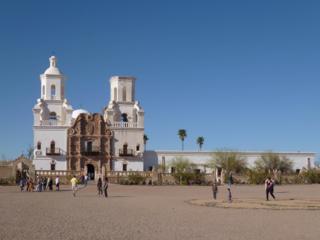
Just a few miles north of the Mexican border I visited the Franciscan-run mission of San Xavier del Bac and learned that is actually had a Jesuit founder Eusebio Kino, a.k.a. Eusebio Chini or Chino, as other sources suggest. He was born in 1645 in northern Italy. His biography reads like an action film with an intense scratchy soundtrack from the 1950s. Recovering from an illness he was drawn to the priesthood and the example of St. Francis Xavier.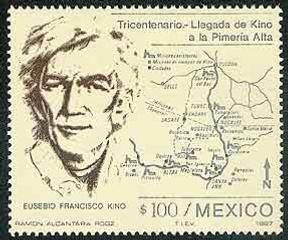
Kino followed the traditional and rigorous sequence of Jesuit formation: regency, theology, and tertianship in Germany before ordination at the age of 32 in 1677, exactly 12 years before Bach and Handel arrived on the German scene. Trained in mathematics and science, he was sent to the missions, via Spain and onward to Mexico his real destination where he could concentrate on astronomy and cartography as well as on missionary activity – each interest fueling the other two.
After much negotiation he finally receives permission to work with the indigenous peoples of the Pimeria Alta, the landmass that is now Arizona and Sonora, in Northern Mexico. His exploration and cartography resulted in the first map to prove that the Baja peninsula in today’s California was not an island, which was widely believed at the time.
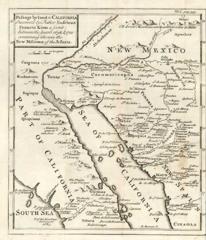 A true missionary, be brought new skills to these traditional cultures. He encouraged people to plant wheat, beans, and other annual crops. He brought animal husband skills, encouraged cattle farming, and spent endless brutal weeks in the saddle, traversing this harsh, desert terrain.
And, of course, he encouraged those he met to contemplate the Christian worldview. One of his earliest mission communities was San Xavier del Bac. Given his experiences in Spain, Kino could share a common experience of the impact of missionary enterprise on a traditional culture and country. This is how Kino explained it in a 1692 letter:
I spoke to them of the Word of God, and on a map of the world showed them the lands, the rivers, and the seas over which we fathers had come from afar to bring them the saving knowledge of our holy faith. And I told them also how in ancient times the Spaniards were not Christians, how Santiago came to teach them the faith, and how for the first fourteen years he was able to baptize only a few, because of which the holy apostle was discouraged, but that the most holy Virgin appeared to him and consoled him, telling him that the Spaniards would convert the rest of the people of the world. And I showed them on the map of the world how the Spaniards and the faith had come by sea to Vera Cruz, and had gone in to Puebla and to Mexico, Guadalaxara, Sinaloa, and Sonora.
Within five years a community was forming around the rancheria that became San Xavier del Bac.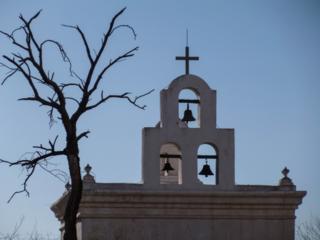
On the thirteenth of January, 1697, I went in to the Sobaipuris of San Xavier del Bac. We took cattle, sheep, goats, and a small drove of mares. The ranch of San Luis del Bacoancos was begun with cattle. Also there were sheep and goats in San Cayetano, which the loyal children of the venerable Father Francisco Xavier Saeta had taken thither, having gathered them in Consepcion at the time of the disturbances of 1695. At the same time, some cattle were placed in San Xavier del Bac, where I was received with all love by the many inhabitants of the great rancheria, and by many other principal men, who had gathered from various parts adjacent. The word of God was spoken to them, there were baptisms of little ones, and beginnings of good sowings and harvests of wheat for the father minister whom they asked for and hoped to receive.
And soon it would be time to build a church. This is from one of Kino’s letters in April 1700: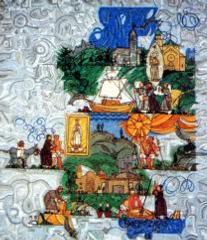
28. … On the twenty-eighth we began the foundations of a very large and capacious church and house of San Xavier del Bac, all the many people working with much pleasure and zeal, some in digging for the foundations, others in hauling many and very good stones of tezontle from a little hill which was about a quarter of a league away. For the mortar for these foundations it was not necessary to haul water, because by means of the irrigation ditches we very easily conducted the water where we wished. And that house, with its great court and garden nearby, will be able to have throughout the year all the water it may need, running to any place or work-room one may please, and one of the greatest and best fields in all Nueva Biscaya.
29. On the twenty-ninth we continued laying the foundations of the church and of the house.
 For the next eleven years, Kino travelled endlessly on horseback as he continued his cartographical work and encouraging the adaptation of crops and cattle. He died in one on his missions in 1711 at the age of 65.
The mission at San Xavier del Bac was eventually taken over by the Franciscans, who still minister there today. This highly elaborate church is at once a pilgrimage site and tourist destination. And it is how and where I learned about Kino only a few weeks ago, now.
In a hagiographic introduction to his 1919 collection of Kino’s letters (that Kino entitled Celestial Favours), Herbert Eugene Bolton offers this capsule portrait:
[H]e prayed much, and was considered as without vice. He neither smoked nor took snuff, nor wine, nor slept in a bed. He was so austere that he never took wine except to celebrate mass, nor had any other bed than the sweat blankets of his horse for a mattress, and two Indian blankets [for a cover]. He never had more than two coarse shirts, because he gave everything as alms to the Indians. He was merciful to others, but cruel to himself. While violent fevers were lacerating his body, he tried no remedy for six days except to get up to celebrate mass and to go to bed again. And by thus weakening and dismaying nature he conquered the fevers. [Spain in the West, (Cleveland: Arthur H. Clarke, 1919).]
Kino’s cause for sainthood was picked up in the 1960s and is now being advanced by American, Mexican, Italian, Franciscan, and Carmelite, and Jesuit supporters. There is a lot of energy around this potential canonization.
There are regular “Kino Cabalgatas” – horseback pilgrimages that recreate some of Kino’s extensive journeys in the saddle. There’s an Arizona/Mexican organization called Por Los Caminos de Kino– followers of Kino’s way, both literal and figurative as a role model.
On the political/humanitarian front there is a US/Mexican Jesuit project named after him, the Kino Border Initiative, founded in 2009 to provide humanitarian assistance to failed Mexican migrants who have been deported from the US. Volunteers and staff from the Initiative meet them on the Mexican side of the border and provide food and other aid and support,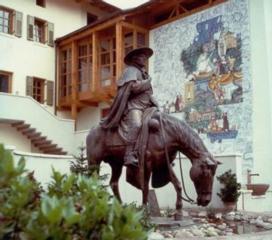
In 1987, when Pope John Paul II was in Arizona and not yet a saint, in one of his homilies he said this about Kino:
Certainly, the Cross of Christ has marked the progress of evangelization in this area since its beginning: from the day, three hundred years ago, when Father Eusebio Kinofirst brought the Gospel to Arizona. The Good News of salvation has brought forth great fruit here in Phoenix, in Tucson and throughout this whole area.
As the saint-loving and constantly saint-making John Paul II knew, all manner of interests and organizations stand to benefit greatly from all the p.r. harvest that comes with such elevated status and interest.
These enthusiasms can often blur the real individual behind it all and they become less of a complex living, breathing, sweating, saddle-sore human, and more of an ideologically buffed-up role model, intended to serve a different kind of purpose. A “corporation” of saints can cast a long shadow on the communion of saints.
++++++++++++++++++++++++++++++++++++++++++++++++
Here are some Kino sites I looked at to find out more about him:
San Xavier Del Bac Mission http://www.sanxaviermission.org/
Padre Kino Organization http://www.padrekino.com/
Kino Border Initiative http://www.kinoborderinitiative.org/
Kino’s letters can be found at the Internet Archive: https://www.archive.org/details/kinoshistoricalm00kino
+++++++++++++++++++++++++++++++++++++++++++
This article orignially appeared in the May Blog – “More Than 7 Stories” (www.sevenstories.ca) and is reprinted with permission.

No Comments