



Surviving Catastrophe: How Catherine and Frederick Stymied Popes

When I read Philip Shano’s recent item on the suppression of the Jesuits I realised how much Catholic history I’d forgotten. I did remember that there were two “Great” Jesuit supporters and holdouts: Frederick and Catherine. Shano’s article sent me back to the work of the Jesuit and historian, William Bangert, gathering dust on my bookshelf, to remind me why these monarchs openly contradicted such an unambiguous papal directive. 
This is what I found in Bangert: What got the goat of these “Greats” was that in the summer of 1773 Pope Clement XIV wrote Dominus ac Redemptor, announcing to loyal Catholics around the world that the Society of Jesus was officially no longer in business.
Why did he do that? Bangert says blame the French royal family – The Bourbon’s – and their influence on a weak Franciscan pope. The politics and the intrigue outlined by Bangert are complex, but the outcome was clear. The pope had decided that the Jesuits were dissolved, everywhere. Bangert explains that in the document of suppression, Pope Clement
enunciated the principle that not only guilt of serious crime but also, on an even wider and broader basis, the interior harmony and tranquillity of the Church is justification for the dissolution of a religious order. He enumerated a long list of charges against the Society but avoided passing judgment on the validity of these charges. Looking back into the Society's history, he recalled that its institute, encountering severe criticism, occasioned grave discord, but he did not claim that this criticism was justified. He recalled the distress of earlier popes at the dissension among Catholics in regard to Jesuit doctrinal teaching, but refrained from affixing blame to the Society.
In the line that follows, Bangert offers a really unsettling summary of what Pope Clement managed to do.
 The Dominus ac Redemptor suppressed the Society but without condemning it.
A mixed papal message, then, and one that did not play well in Prussia where Frederick the Great was starting to enjoy life once more at his royal palace, Sans Souci, in Potsdam. It was there that he wined and dined the Enlightened – including Voltaire and Johann Sebastian Bach – and corresponded with Diderot and d’Alembert of Dictionary fame. Bangert explains why the dissolution wasn’t going to go down well in Frederick’s Enlightened Prussia with its long-established network of Jesuit schools:
Frederick was a late convert to the cluster of European admirers of the Jesuits. Before 1768 he kept pace with any of the apostles of the Enlightenment in his contempt for the Society, the abolition of which ‘noxious vermin’ he warmly advocated. But his preoccupation as a child of the Age of Reason with the worth of education transformed his attitude toward these experienced teachers. His military and predatory policies brought him into contact with Jesuit schools, and with his sense of statesmanship he recognized their contributions to the culture of his realms.
In 1769, just before the election of Clement XIV, suspecting the inevitability of the suppression, he announced to D'Alembert that it redounded to his personal honor to preserve some fragments of the Society, and warned the Frenchman that his country would one day regret its action against the Jesuits. Through his Roman agent he advised Clement XIV that, regardless of developments elsewhere, he intended to keep the Society intact in his states.
Frederick’s strategy was simple and turned canon law upside down. He told all the bishops that he had forbidden the publication of the suppression document within his kingdom.
He informed the provincial of the Jesuits in Silesia … about his directive to the bishop, and ordered that the Jesuits continue their work. So began three years of mental disquiet for the Jesuits… Frederick's order threw them into a quandary, raising as it did a technical but important point of canon law [because] … correct canonical procedure for the promulgation of Dominus ac Redemptor, as distinctly delineated in the instruction of the cardinals who were supervising the suppression, demanded that the notification of the brief be given in each Jesuit community by the local bishop, and that, until this was done, no Jesuit could feel free of his obligations as a religious of the Society.
What Prussian Catholics didn’t know wouldn’t hurt them. And that meant business as usual in Jesuit run schools. The king and the pope began horse trading and, after two years of wrangling,
both sides eased their demands and moved toward a reasonable solution. From a baffling maze of details the central issue which emerged was whether the Society should retain its character as a religious order.
What helped these negotiations was that following Clement XVI’s death in 1774, the next pope, Pius VI, was somewhat ambivalent about his predecessor’s directive:
 By the end of 1775 Pope Pius VI and Frederick arrived at substantial agreement. Pius was willing to allow the Jesuits to continue their corporative work in church and school, even to accept recruits, but on condition that they function not as members of a religious order but as individuals under the jurisdiction of the bishops. Frederick, for his part, while unable to grasp why the pope was so adamant on depriving the Jesuits of their character as religious, received what he basically wanted, the guarantee of their presence as educators.
On January 3, 1776, the king issued orders that the Society of Jesus be dissolved in his realms. Six months later, to this new, somewhat anomalous corporative unit, he gave the title: Priests of the Royal Schools Institute. This Institute lasted twenty-four years, until 1800.
Thus the Jesuits remained in Prussia operating under a new name. Meanwhile in Russia, Catherine the Great was not going to be told by a French-influenced pope how to run things in her kingdom. Bangert explains:
Catherine refused to be intimidated and, asserting her position as mistress of her own house, repudiated outright all Bourbon interference in what she regarded as a domestic problem. By November, 1782, she became nasty, threatening to abolish religious freedom for the Catholics in White Russia and to convert them to the Orthodox Church. The Bourbons retreated. One factor that contributed to Catherine's triumph was the war in the American colonies. During this conflict Russia followed a policy of neutrality. So strenuous had Catherine's expression about the novitiate become that the Bourbons, allies of the Americans, feared that they might push Catherine away from her position of neutrality into the English camp.
As with Frederick, her approach to “diplomacy” was tough.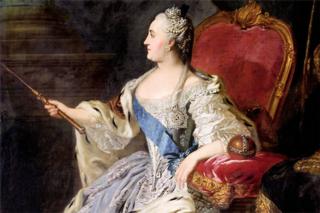
Catherine sent Jan Benislawski, former Jesuit and now a canon in Vilna, to Rome, bearing three requests to be made of the pope, one of which was for papal confirmation of the Society and approval of each step the Jesuits in Russia had taken at her command. Three times Pius received Benislawski and discussed with him the Russian demands.
At the last audience, on March 12, 1783, he acceded to Catherine's triple request. On the point of the Society's continued existence in Russia, he three times said, "I give my approval." Ten years had elapsed since Clement XIV had issued the Dominus ac Redemptor, and Catherine received the reward of her decade of intransigence as Rome and St. Petersburg had reached at long last accord on the irksome issue of the Society of Jesus.
In 1814, another Pius, Pius VII, restored the Society of Jesus and this time there were no Greats to oppose the decision. Bangert points out that the Jesuits were effectively invisible all through the turmoil of the pre- and post-French Revolutionary period.
And so it happened that, apart from the tiny fragment in White Russia, the Society, invariably engaged in the thick of the Church's conflicts, was absent from the scene of one of her most agonizing battles.
 What Philip Shano’s article provoked in me, and why I waded through these details, was that in addition to wanting to get the history clear in my mind, I wanted answers to another question. After 41 years of invisibility, how was it that the Society of Jesus managed so quickly to re-establish itself around the world?
Bangert offers a hint at the conclusion of his chapter.
Through the decades of revolutionary chaos it continued to have the fire to capture the hearts of youth, and these young men were on hand, when the day of reestablishment dawned, to give assurance to the aged survivors of the catastrophe that the Ignatian vision would live on.
But how did those “aged survivors of the catastrophe” manage to do it? I think answers to that question will offer insight into what Michael Higgins describes as the enduring “Jesuit mystique.” This blog, IgNation, might just be a place to share them. Yes?
+++++++++++++++++++++++++++++++++++++
(All the quotations in this piece are from Chapter 6 – 1757-1814. Exile, Suppression, and Restoration in A History of the Jesuits, William V. Bangert, S.J., (3rd edition) published by the Institute of Jesuit Sources in 1986.)
A website on the Restoration can be found at www.sj2014.net

No Comments