



The Happiest People on Earth

In June of this year I moved from Toronto, where I had been doing my philosophy studies, to Vancouver, where I began a two-year research position in astrophysics at the University of British Columbia. I have received a warm welcome here—and I was lucky to arrive during the best time of the year weather-wise.
 One of the blessings of belonging to a religious order is that when you move, most of the time you are moving into an established community. There is no need to hunt for an apartment, and you find yourself among brothers who know how things work in your new home. In my case, it has also meant that I have gotten a great introduction to British Columbia. I have already had the opportunity to make a few excursions on my days off to see Vancouver and its environs.
One such excursion has had a lasting impression. A couple of weeks after arriving, I accompanied my fellow-Jesuit-in-formation John O’Brien, S.J. to Mission, a town about an hour and a half east of Vancouver.
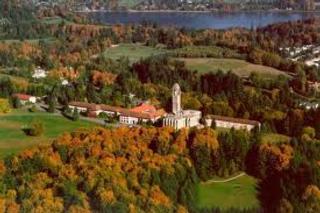
We arrived in time for Sunday mass at Westminster Abbey, a community of Benedictine monks. I have not spent much time among monks of any tradition, but I have visited enough monasteries to know that lives spent in prayer and work create a deeply peaceful atmosphere. Being on the abbey’s property one feels a slower and more joyful rhythm of life. Their liturgy—spare, reverent and unhurried—only adds to the infectious spirit of prayer and communion with God.
The Benedictines are not the only contemplatives in Mission. After having luncheon we headed up to St. Clare’s Monastery, home to a community of Poor Clares. John wanted to take me to visit one of his friends who is a nun in this monastery.
It was my first time meeting any sister of this religious order, and I lucky to be treated to a visit with the whole community. Given their cloistered life, which is dedicated to praying the Divine Office and contemplation, the rest of their time given up to the various jobs and chores necessary to make a living and keep up their monastery, it is not very often that they will all gather together to receive visitors.
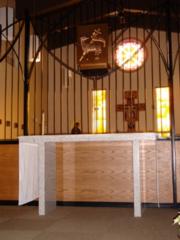 We met in their guest room, in which, to respect their cloister, a waist-high wooden barrier separated us from them. What struck me immediately was their radiant joy: animated, inquisitive and quick to laugh, they carried the conversation here and there, asking about our lives and telling us a bit about theirs. They could moved between humour and gravitas effortlessly as the situation demanded, illustrating that joy is something more profound than any surface emotion. When the mother superior called the visit to an end, it seemed as though it had been ten minutes rather than forty.
I have often thought of those sisters since our visit over two months ago. Though they are hidden away from the world, they offer so much to it. What, though, is it that they give? Certainly they pray for us, which is a great blessing that we probably do not remember often enough. But to leave it at that is to define them merely functionally. Ultimately, these simple women are living on earth something of the contemplation that is our common Christian destiny: the contemplation that consists of sharing in God’s divine life. Somehow, the hidden lives of these nuns must soak into the rest of the world.
 During my recent studies in Toronto, I learnt that many of the greatest philosophers believed that human happiness consists in contemplation. This certainly made sense to me when I studied it, but it always help to be given concrete instances of abstract principles, and my visit to Mission did just that. Doubtless the monastic vocation is difficult at times and is not for very many Christians. It is not for me. For most of us, the way to perfection involves a more active life. But thank God that some are given the grace to live it this side of heaven.
As we were driving home in the evening, I mentioned to John the joy that I had sensed in the nuns—as well as the monks—that we had met that day. He just smiled and said, “Yes. They’re the happiest people on earth.”

No Comments