



At Home in The Fog
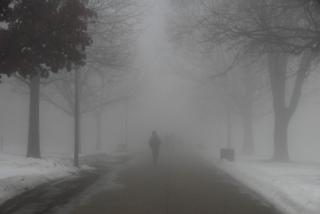 The land finally succumbed. Resistance had weakened in the cool of the evening.
Nothing could stop it now. Slowly, quietly, in the hush of dusk, it crept landward, draping the headlands in its cool, moist embrace. Funneling up harbours and valleys, wafting through open windows, shrouding all in silence, it advanced, relentlessly. The darkened land would now sleep, blanketed in the shroud of night.
I think that fog lives in my bones. For sure, it lives in my heart and soul. I happened to be born not far from the confluence of those two great Atlantic arteries, – the Gulf Stream and the Labrador Current. Their intercourse produces the best fog in the world.
The Gulf Stream transports warm waters from the tip of Florida, along the Atlantic Seaboard, out past Newfoundland on its way across the Atlantic to western and northern Europe. Over 100 km wide and a kilometer deep, its cruises along, pushing over 150 million cubic meters per second as it passes south of Newfoundland.
Running in the opposite direction is the cold Labrador Current, transporting frigid waters from the high Arctic, along the Labrador coast and around Newfoundland. That cold tongue of life brings the countless icebergs calving off the heights of Greenland. And with the ice come the millions of harp seals, birthing on the solid pans of sea ice. The polar bears follow, gorging on the feast.
On the Grand Banks, the tongues of cold and warm kiss, spawning the well-known summer fogs of Newfoundland and the north Atlantic. The coming of the wet, cold fog signals what we call "capelin weather", that time of early summer when million of silvered capelin roll upon Newfoundland beaches in an orgy of sperm and egg.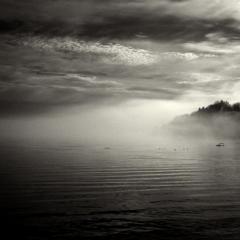
Humpback whales follow the capelin on their journey north to feed in the rich, cold waters. Ever smell the "burp" of a humpback? One such burp from a humpback almost knocked me off my feet, so strong was the stench of partially digested capelin.
Each day welcomes the rising eastern sun that slowly eats away at the marauding fog. Beaten back by the steady, warm gaze the fog retreats seaward, letting the land once again have its day in the sun.
But the fog does not go far. Only a kilometer or so, out on the water, far enough away from the deadly heat of the land, the mammoth fog banks brood, patiently biding their time when they may again advance and reclaim the land. And wait they will, if the wind is right. The land can resist only for so long. The cool of the evening will again fall upon the land – and the daily tug of war will continue.
Sometimes, advancing strands of fog attempt to pierce the barrier of heat simmering over the land. Scouts of fog foray forth, advance in earnest, only to be beaten back under a phalanx of solar defense. But they know that their time will come, especially as the days of summer advance and the sun loses it grip upon the land.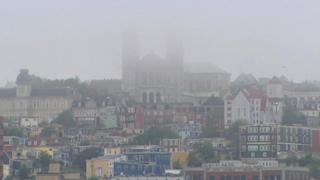
A difference of 10 degrees can mark one end of St. John's from the other. We always called late summer (after the first of August) as "sweater weather." A good friend likes to quip that Newfoundland has two seasons – winter and August. Not exactly true, though not far from it. Coastal fog does much to command the weather of northeastern Newfoundland.
We are defined by the nature that surrounds us. Fog defines northeastern Newfoundland. We may curse it. We may love it. Let the foghorns wail and the whales rejoice.

No Comments