



Tales from the Inky Way #2 – The Doctor Will Not See You Now – Dr. Jane Paulson

For over a decade now, as August fades to September, each year at this time I remember the late Dr. Jane Poulson, who died August 28, 2001.
In the final months of her life I worked briefly with her at her home and over the phone as she completed her memoir: The Doctor Will Not See You Now: The Autobiography of a Blind Physician (Novalis, 2002).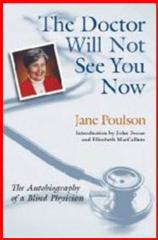
Our final working sessions on that book took place in that hot summer of 2001. I had been working as a commissioning editor for a year and was still learning on the job. I will never forget the experience of working with an individual who knows that time is running out. Working with her has set an indelible mark on my work with writers and also with individuals who are determined to live “around” a serious handicap.
That final work-session with her was at her bedside in Toronto’s Princess Margaret Hospital. Outside, people were wilting in a late summer heat-wave. In the chill of her air-conditioned hospital room, and between countless interruptions for one medical procedure or another, we leafed through all the pages on final time. Our goal was to shape the sequence of the final chapters of her book which she had written under very challenging circumstances.
Three weeks later, in the palliative care centre at Toronto’s Grace Hospital, Jane Poulson died. She was 49.
But let me take you back to the birth of her book. A few months into a new publishing job, my predecessor, Stephen Scharper, sent me a chaotic bundle of autobiographical pieces that he thought contained the seeds of a book. I was on the train on my way home to Ottawa after a publishing meeting in Toronto and by the time the train pulled into Kingston, I was convinced that this wild collection of pages could become a deeply moving book.
What had she written?
At the recommendation of the late Most Reverend Edward Scott, who at the time was primate of the Anglican Church in Canada, Jane Poulson had drafted a series of autobiographical and reflective pieces about her life and work, her hopes and fears, and her faith. A devout Anglican, Jane was also greatly influenced by a Catholic hospital chaplain in Montreal, Father Paul Geraghty, and also the Very Reverend Douglas Stoute of Toronto. This trio of one Catholic and two Anglican mentors encouraged Jane to share her remarkable story with an audience beyond Canada’s medical establishment. They encouraged her write openly and generously, to go beyond the privacy of a personal journal, and to address something of her Job-like experiences that had become part of her remarkable work as a doctor. A doctor and patient, together in pain, comprise a different kind of healing partnership.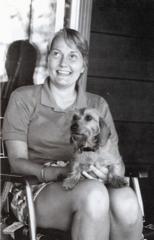
Jane took on the writing challenge in much the same way as she approached everything else in her life: with great conviction, unrelenting determination, a wild sense of humour, great energy, occasionally wonderfully raw “NSFW” language, and great technical precision. And with a superb recall of detail.
In brief: Jane Poulson was born in Toronto in 1952, attended St. Clement’s School, Havergal College, and Queen’s University, then moved to Montreal to study medicine at McGill. While still in grade school she was diagnosed with a severe case of insulin-dependent diabetes. Shortly before completing her medical studies she had lost what remained of her vision. At that time, computer-based assistive devices were in their infancy and higher education and (especially) Canada’s professional gatekeeping organizations offered relatively little accommodation for anyone people with serious disabilities. Fortunately, Jane Poulson did not regard her blindness that way. “It was time for me to start learning how to be blind,” she wrote, “and at the same time to find my place in the profession I so loved and was determined to pursue, my handicap notwithstanding. This is a never-ending journey for me and, like any important venture, it started with practical and immediate little steps.”
The Doctor Will Not See You Now, is filled with the frustrations and the moments of elation, of being floored by and then eventually succeeding with all those messy “immediate little steps” and the many “smashing crack-ups” as she called them. She challenged Canada’s medical establishment to find ways to examine people like her who happened to be blind, and who were accomplished and determined medical student. And they did.
When fully qualified, Dr. Poulson had to instill confidence in her initially and understandably tentative patients. And she did.
She refused to settle any kind of easy, limited form of accommodated medical practice. And she didn’t.
 As a doctor, a researcher, and a gifted teacher, she knew the depths of what she had to offer her profession and her patients. She pursues serious medical research and innovative practice in internal medicine which eventually led her to focus on palliative care. And that’s what she did, successfully, and on all fronts, first in Montreal and later in Toronto, where she was eventually named a Fellow of Massey College. Then, in 1987, at the age of 35, she was awarded the Order of Canada which identified her as the “first blind Canadian physician to qualify as a specialist in internal medicine and become a Fellow of the Royal College of Physicians and Surgeons of Canada.”
Diabetes and blindness were not the only serious health challenges she faced. Eventually cancer took up residence in her already ravaged body. Her own physical and mental health issues, she made it abundantly clear, helped to make her an even better doctor. In the Introduction to Jane’s book, her dear friend Elizabeth MacCallum writes:
A few years into her battle with cancer, she began writing…seminal articles on patient care and cancer…After giving a lecture on patient care using her now double-sided experience, the first talk she’d given in over a year of her illness, she was subdued. "There wasn’t much audience reaction," Jane reported. After considerable silence she went on: "I was surprised how many women who have breast cancer came to speak to me afterwards." After more discussion she said, "The guy who invited me to talk came to me later and asked if everybody always cried during my lectures."
If you’re blind, others’ tears are secret.
Elizabeth’s husband, John Fraser, is the Master of Massey College and he co-authored the Introduction. He captures Jane’s magnetising impact on everyone she met.
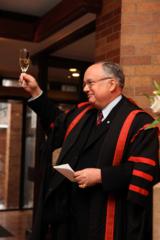
Whenever she felt she had a triumph – beating back cancer, getting a new job, greeting the return of spring, et cetera – she would dial up the College catering office and book the Common Room or the small dining room or the Upper Library and throw a party. Usually with a band, always with an open bar and the very best food. These parties, I am convinced, were an extension of her duties as the Chapel Mistress.
Early on in our work together I remember complaining to Jane that reading the manuscript pages she kept sending me was like looking at an old telephone directory from a distance. The margins were extra wide and the font was tiny, as somehow she had set her computer in 6- or 7-point type on many of the pages. She dead-panned, “Then try reading type when you are blind!”
In a matter of months and through a series of lengthy telephone calls and some unforgettable working sessions together in her home in Toronto, we found a way to organize all the printouts and files that eventually became the 252 page

s of the final published book. In that summer of 2001, before I left her hospital room for what we both knew would be the last time we spoke to each other, and knowing that she would never get to open the final printed book, I said, “Jane, hold out both your hands.” And she did.
I placed the heavy binder in her waiting hands and said, “Jane, this is your book. Careful! It’s a quite a heavy piece of work!” And she laughed.
I feel truly blessed to have met Jane and to have learned about her life in that strangely intimate way an editor does when working with a deeply trusting and utterly fearless author. The publication of her book, several months after her death, was another Poulson accomplishment. Given the role of vision health in the book, I connected the publishing house, Novalis, with the Canadian National Institute for the Blind. When it was released in 2002, The Doctor Will Not See You Now appeared in multiple formats on the same day: print, audiobook, DAISY, and Braille (this was just before e-books arrived on the scene) making it the first book in Canadian commercial publishing history to be released in accessible formats simultaneously.
And of course, Jane must have the last word:
"I see all that I do now through a different lens….When you presume to have infinity before you the value of each person, each relationship, all knowledge you possess is diluted. My life now is concentrating before me. This is the most painful yet enriching experience of my life. I have found my Holy Grail: it is surrounding myself with my dear friends and family and enjoying sharing my fragile and precious time with them as I have never done before. I wonder wistfully why it took a disaster of such proportions before I could see so clearly what was truly important and uniquely mine."
+++++++++++++++++++++++++++++++++++++++++++++++++++++++++++++++++++++++
The Canadian Medical Association still has 2 articles by Jane Paulso online:
DEAD TIRED: www.cmaj.ca/content/158/13/1748.full.pdf+html?sid=94f508c7-8ffe-48bd-a946-e04585b9f83d
THE DAYS THAT WILL STILL BE MINE www.cmaj.ca/content/158/12/1633.full.pdf+html?sid=94f508c7-8ffe-48bd-a946-e04585b9f83d
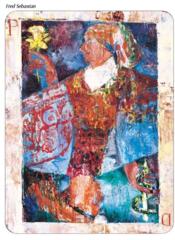
And in another CMAJ item, Dr. Neil MacDonald remembers Jane Paulson – (includes the Frederick Sebastian art work ifound above)

No Comments