



From Suffering to Peace Building
At the beginning of August, Cardinal Peter Turkson, President of the Pontifical Council for Justice and Peace, participated in the “Ten Days for Peace” programme sponsored each year by the Catholic Church in Japan. Here is a sample of the addresses he gave on that pilgrimage:
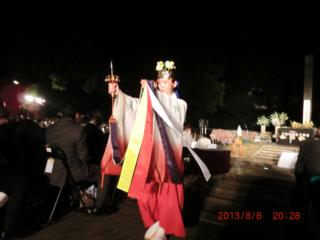
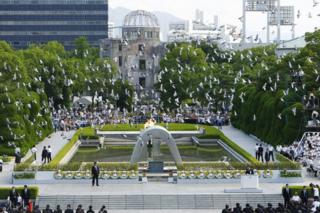 The atom bombs of 6 August 1945 at Hiroshima and of 9 August at Nagasaki are, in the words of Pope John Paul II, a “frightful wound inflicted” upon the people of Japan and the whole human family. On their 68th anniversary, I felt honoured to participate in Ten Days for Peace, to pray for the victims, to denounce the madness of war and seek conversion to peace-making. Such an invitation one accepts, not as a tourist nor even as a guest, but only as a pilgrim.
We represent some of the great religious and spiritual traditions of Asia – Buddhists and Shintoists, Christians who are Evangelical / Reformed / Protestant and Catholic – as well as contemporary global secularism. Each tradition can explain its vision as we come on pilgrimage to a memorial of untold horror and destruction
According to Catholic belief, God made man for life, for freedom and for happiness. This is obviously what each of us wants most deeply.
And yet our destiny on earth, much of the time, seems to consist not of freedom and happiness but of suffering. Confused and discouraged, we are tempted to undergo suffering as chastisement or punishment, as cruel fate. Such senseless suffering can eventually defeat us.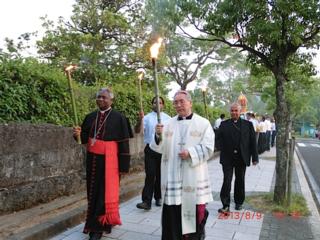
But here in Japan in 1981, Blessed John Paul II properly named the suffering wrought by war, specifically by the Atom Bomb, as the fruit of human sin and the result of evil at work. And the idea was developed in 2010 by the future Pope Francis: “The possession of atomic power can cause the destruction of humanity. When man becomes proud, he creates a monster that can get out of hand.” Even the civilian use of nuclear power seems to run such a risk. The 11 March 2011 earthquake and subsequent tsunami off Japan’s eastern coast destroyed the Fukushima nuclear power plant, causing meltdowns at some of its reactors, hydrogen explosions, and radiation leaking into the air and the sea.
Individuals and societies are always tempted by the passions of greed and hate; but they do not have to succumb. Instead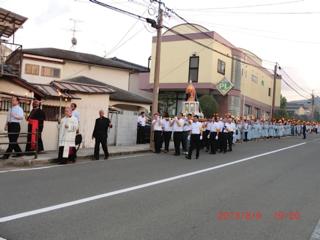 of excluding those who are deprived, let us meet their needs. Instead of avoiding those who suffer, let us accompany them. Instead of cursing what we ourselves suffer, let us offer it up for others. Instead of hiding from today’s problems, let us together bravely address the social situations and structures that cause injustice and conflict. “Peace or the survival of the human race,” Blessed John Paul insisted in 1981, “is henceforth linked indissolubly with progress, development and dignity for all people.”
Fifty years ago, at a time of serious nuclear threat, Blessed John XXIII published his historical encyclical, Pacem in Terris, urging that peace be rooted in human dignity and built on the solid foundations of truth, justice, charity and freedom. Subsequent Popes have kept reminding the world that peace is inclusive and indivisible: one segment of a population cannot enjoy peace while other segments are suffering exclusion, deprivation, injustice and violence. For “no amount of ‘peace-building’ will be able to last,” Pope Francis warned on 25 July during his visit to the Rio slum of Varginha, “nor will harmony and happiness be attained in a society that ignores, pushes to the margins or excludes a part of itself.” Whom does our segment of society ignore, marginalize or exclude?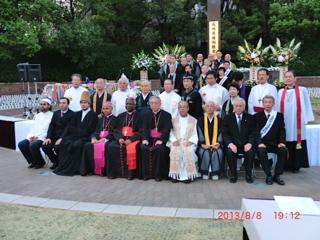
Real peace-making is to include and to integrate those on the peripheries. Then, according to the Christian faith, we join Jesus Christ in the saving logic of His Cross. With St. Paul we affirm that “death is swallowed up in victory,” and we can triumphantly demand: “O death, where is your victory? O death, where is your sting?” (1 Cor 15:55)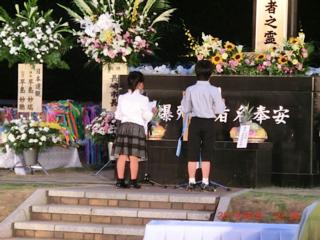
Peace, therefore, is the fruit a great collaborative enterprise between God and humanity. For while God is always offering this supreme gift to His creation, humankind must receive it and assiduously work for it in laboratories of love. From victims of suffering crushed by war, each of us, and our faith communities are invited to honour the memory of Hiroshima and Nagasaki by forgiving, as the necessary first step, and in collaborating in solidarity to build real peace.

No Comments