



Humility: Knowing Our Place in the World
 One of the words that has been used a lot to describe Pope Francis since his election is the word humility. What is humility? It might be helpful to name some of the words we use for its opposite – pride, vainglory, self-centredness, and narcissism. I knew a man who ended a long narcissistic monologue by saying, “Well, enough about me! What do you think of my decision?” I hoped he was teasing, except everything I knew about him told me he was rooted in an obsession with himself and his self-importance. He could have benefitted from C.S. Lewis’s reminder that “humility is not thinking less of yourself, it’s thinking of yourself less.” That’s actually a very good definition because another opposite of humility is having too low a view of yourself, often described as false humility.
Humility is rooted in human self-awareness. It is presenting one’s real self to others, not some projection. The humble person is honest and knows herself and her imperfections and sinfulness. She knows that she is utterly dependent on God and others. The humble man has a modest estimate of his worth. Saint Bernard defined humility as “A virtue by which a man knowing himself as he truly is, abases himself. Jesus Christ is the ultimate definition of humility.”
The word humility is taken from the Latin humus, which is translated as “soil” or “ground.” So, when we speak of Pope Francis being humble, we are saying that he is lowly, close to the earth, close to those around him. Saint Francis of Assisi is often held up as a model of humility. Interestingly enough, recent studies on leadership show that leaders who possess humility are usually quite effective. The research suggests that humility includes self-understanding and awareness, openness and perspective taking. Pope Francis seems to fit the profile.
 Most of us do not aspire to be humble. We usually prefer places of honour and respect to positions that are humble. That is why Jesus had to remind us that “all who exalt themselves will be humbled, and those who humble themselves will be exalted” (Luke 14:11). Humility also has an Old Testament parallel – the anawim, Yahweh’s poor who are totally dependent on God. They are the ones referred to when we sing, “The Lord hears the cry of the poor.” Psalm 34 proclaims that the Lord is near to the brokenhearted and the Beatitudes remind us, “Blessed are the poor in spirit, for theirs is the kingdom of heaven” (Matthew 5:3).
The perfection of Christian humility is Jesus himself. Saint Paul sums it up. “Christ Jesus emptied himself, taking the form of a slave, being born in human likeness. He humbled himself, becoming obedient to death, even death on a cross” (Phil 2:7-8). There’s also the image from John’s Gospel of Jesus washing the feet of his disciples. We know, as well, that this trait of humility and lowliness was found in his mother Mary.
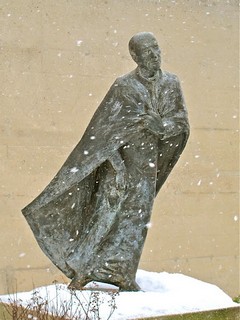 Saint Gregory the Great (540-604) described humility as “the mother of all virtues.” The Rule of Saint Benedict has twelve degrees of humility. Saint Anselm lists seven degrees. Saint Ignatius of Loyola managed to reduce humility to three degrees. In the exercise on the Three Kinds of Humility, he is suggesting that there are three kinds or degrees of the love of God – love of the creature, love of the servant, and love of the friend. Ignatius desires that our relationship to Christ be marked by intimate knowledge and friendship.
The third kind of humility is described by Ignatius. “This is the most perfect kind of humility. In order to imitate and be in reality more like Christ our Lord, I desire and choose poverty with Christ poor, rather than riches; insults with Christ loaded with them, rather than honours; I desire to be accounted as worthless and a fool for Christ, rather than to be esteemed as wise and prudent in this world. So Christ was treated before me.”
Most of us probably associate more with the first two kinds of humility. Not many of us are called to be fools for Christ. I would be reluctant to associate Pope Francis or anyone with a certain level or grade. Thomas Merton said, “Pride makes us artificial and humility makes us real.” If Pope Francis had changed his personality on the first night after his election, that would have been artificial. Instead, we are seeing the reality of this man. He is bringing his own personality to a role that is traditionally filled with pomp. That is not him.
Humility is a tricky quality. One can never claim to be humble. To do so is to be filled with pride. Only others can state that someone is humble. It is probably a struggle for Pope Francis to hear himself described as humble. If the words of people go to his head, he could start believing it and slip into pride. I can aspire to it, yet such ambition is probably a form of pride. Far better to pray to God for the grace to be open to his desires for me.
There is a good definition of humility from the African American poet Maya Angelou. “Humility is knowing your place in the world. It’s understanding that you are not the first person who has ever done anything important.” Pope Francis is no fool. He knows his place in the world and is at ease with it.
No Comments