



Celebrating the Rite of Baptism
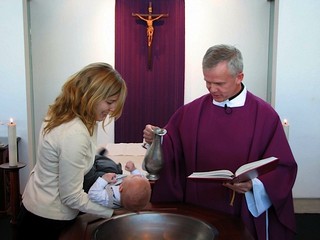 As a Jesuit priest, celebrating Baptism is the one I enjoy the most of all the sacraments. Each of course has its grace and blessing, but there is something special about welcoming an infant into the community marked by the sign of Christ. The celebration is not without its challenges.
Two difficulties people have voiced to me over the years are these: What does it mean for an infant to be baptized in Christ? And, if Baptism is essentially the simple formula of water being poured over the child (or the child immersed in water) with the words “I baptize you in the name of the Father, and of the Son and of the Holy Spirit,” why in fact d o we have such a prolonged liturgy with so many different symbols being enacted and words being spoken?
People do not have problems with the extended liturgy, in fact they rather enjoy it, but they do have questions about what it all means. And so I have developed over the years this response, and usually I address the two questions both in preparation for the baptism and in the actual homily of the liturgy. And I have to admit, I like what I have come to understand about our rite of Baptism, especially the Baptism of infants.
We all know that the main symbol of Baptism is water with both nuances of cleansing and refreshing. Water gives life. I understand Baptism to be the declaration of God through Christ and the community to the infant that resonates like this: “You stand today before all of creation and all of humanity and before God as a creature with great dignity and honour.” This is God’s declaration to the child in Baptism.
All the symbols used in the liturgy invite the community to pray for the child to celebrate God’s declaration of dignity and life. The symbolism of water rests at the centre of the liturgy. I locate three symbols before the use of water and three afterwards for a total of seven symbols in the rite of Baptism.
The very first symbol is the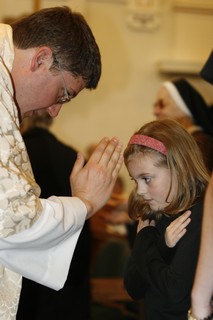 child’s name. The celebrant asks the parents; “What name do you give your child?” The child has a name, and therefore stands as a creature with individuation before us all.
Then immediately afterward we have the second symbol, the sign of the cross on the forehead of the child with the words, “I claim you for Christ,” and parents, god-parents and siblings are all invited to do the same. I especially invite older siblings who most likely do not remember their own Baptism to make the sign of the cross on their little sister or brother.
I was especially moved at a Baptism where the father, who was not baptized, took the hand of his four year old baptized son and helped him mark the sign of the cross on his young baby brother.
After the readings we have the third symbol, the anointing with oil on the chest, with the accompanying laying on of hands and invocation of the Spirit. Oil is a symbol of healing and resilience. We put oil on our skin to heal, to refresh and to strengthen, and this is what God’s declaration of love to the child signifies.
The fourth and central symbol receives great fanfare with a rather long blessing over the water. Water stands for both nu ances of cleansing and refreshing, We become clean with water, and we cannot live without water. God’s declaration of love through the Church both cleanses and refreshes the infant.
After the baptism of water we have three symbols in rapid succession to conclude the liturgy. The fifth symbol is the anointing of the head with sacred Chrism, a fragrant oil that is blessed at the Chrism Mass in Holy Week. Just as Christ was anointed prophet, priest and king, so too is this child.
The sixth symbol stems from the early tradition of the Church, when the newly baptized wore white garments to signify their new life in Christ. The child is clothed in white to indicate this dignity.The seventh and final symbol is the Light of Christ. The Easter Candle has been lit and burning throughout the liturgy and in conclusion the celebrant invites a god-parent to light a candle from the Easter candle who then gives it to the parents saying, “Receive the Light of Christ. ” 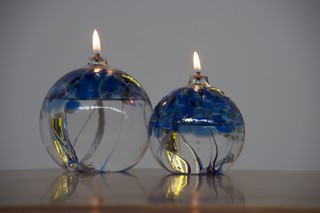
Each symbol invites the community to celebrate the word of love declared to the child which emphasizes their great dignity and honour. Like a “word” that is once spoken, it can never be taken back. The “word” will have its effect whether accepted or rejected during the course of life.
Like a “seed” that is planted the word of Baptism will grow, struggle and prosper according to the life of the child. Each symbol, like a spoken word and a planted seed declares once and for all to the infant: “You are a creature in our midst who stands with great dignity and honour!”
Isn’t this something we all need to hear again and again as we celebrate the Baptism of our children? Perhaps that is why we all renew our Baptismal vows in the celebration of an infant’s Baptism.

No Comments