



St. Kateri Tekakwitha: A Perspective from the Archives
 The canonization of the first North American First Nations Catholic took place in Rome last October 21. For me, the six months leading up to it involved a deepening relationship with the saint.
About a year ago at the Jesuit Archive we began asking ourselves what we might do to mark the occasion. After all, we hold the biography by Fr. Claude Chauchetière, that formed the centre piece of the positio for her beatification by Pope John Paul II. It was written in the years after her death in 1680.
Our resident and highly valued historian, Jacques Monet, S.J. created a fact sheet on the theme of the canonization. Jacques had been inspired by a visit that he and I made to the Kateri shrine in Kahnawake one fine spring day last year.
We were warmly received by Deacon Ron Boyer, a long-time friend of the Jesuits, and his volunteer assistant, Gabriel Berberian, a layman with a particular devotion to the saint.
The rectory dates from the 1600s. It houses the Shrine museum and offices. From its 17th-century foundations until the time of the Suppression of the Society, it was a Jesuit mission. Now the church is a mission of the Diocese of St-Jean-Longueuil.
The St. Lawrence Seaway canal was cut through Reserve land only a few metres behind the church and rectory. No supertankers went by when I was there, but when one does, it must be like a behemoth moving through the tranquil setting.
Ron explained that they see American warships and submarines moving from the Great Lakes naval station near Chicago, as well as freighters. The people passing on board the ships see a huge poster of St. Kateri on the back wall of the church.
It is always a pleasure to visit the Kateri Shrine. The church dates from the mid-19th century. It was designed by Félix Martin, S.J., and the interior frescoes, which are remarkably beautiful, were done by Guido Nincheri, the well known Italian-Canadian artist who decorated many of the churches in the Montreal area.
Félix Martin was one of the first Jesuits to come to Canada from France after the Restoration of the Society. A multi-talented individual, he arrived in 1842. The last pre-Suppression Jesuit, Jean-Joseph Cazot, had died in Quebec City in 1810.
We consider Félix Martin to be the founder of the Archive. Cazot had distributed Jesuit documents among various religious houses in Quebec City. We have such early documents as the biography of St. Kateri because of Félix Martin’s commitment to recover as many of the early Jesuit archives as
possible. 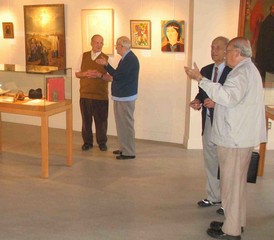
Historical archival work is all about handling traces of the past. At the St. Kateri Shrine museum, one sees a painting done by Claude Chauchetière a couple of years after her death. She is said to have appeared to him and inspired the image. It is as close to a likeness of her as we will ever have, and might almost be considered a relic.
The Archive has offered to help the folks at the Shrine have it restored and encapsulated in a protective enclosure to preserve it.
The museum also houses other images of Kateri and a collection of artefacts, including magnificent First Nations beadwork.
One event helped me see that Kateri has a sense of humour. Len Altilia, S.J. created a vocations’ prayer card with an image of a sculpture of the saint. The statue, about 90 cm high, was in the Jesuits’ Gesù chapel in Montreal. Len had eliminated the detail of the chapel from the background for the card.
The statue got moved sometime after Len photographed it. Last summer there was scrambling around Maison Bellarmin when people were trying to remember where it was, because they wanted to place it in the community chapel as part of the lead-up to the canonization.
Suddenly someone noticed that it was in the community salon, where it had stood in plain sight for months. My theory is that Kateri was playing a trick on her beloved Jesuits. Remember, after all, that the small pox that had afflicted her and left her scarred, had also left her with limited vision.
The evolution of Kateri’s image in prayer cards and other illustrations is worth studying. Of course First Nations iconography and a forest setting (she often went into the forest to pray alone) are
consistent in the pictures . 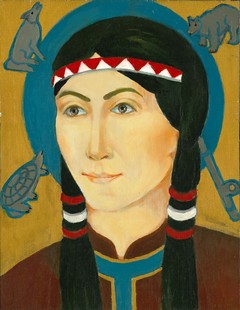
But the range of personality types is remarkable and I suspect that over time one sees a consistency in their evolution, from a pretty Indian maiden to a rather serious and realistic looking woman in the image by Joseph Adolphe that was used on the prayer card created by the Martyrs’ Shrine in Midland to mark the canonization.
The most recent stage in my ongoing relationship with the saint occurred just the other day when some of us at the Archive watched the Salt and Light broadcast created for the canonization. The film shows the remarkable story of the second attested miracle, which took place when the nun who bears the saint’s name placed a first-class relic physically on the boy who was being consumed by flesh-eating disease and then prayed along with others in the Kateri Circle.
We have a first-class relic of Kateri here at the Archive, and at the present time it is reverently displayed as part of an exhibition on Kateri in the lobby of Maison Bellarmin.
The exhibition will be up for about two more months. It displays many items, primarily printed pieces, that have promoted devotion to the Mohawk saint. Also in the exhibit is a TV set where visitors can watch DVDs of the videos David Shulist, S.J. made when he went with a group of First Nations people to Rome for the canonization.

No Comments