



Jesuit and Priest
 I have always wondered at the fact that all of the first companions of St. Ignatius were priests before they were Jesuits. In this light, I have reflected on the question, "do I think of myself as a priest who is a Jesuit or a Jesuit who is a priest?"
… Ignatius' life [represents] a totally original way of combining presbyteral ministry and the religious life… In the combination each term undergoes a change in meaning. That is why the question is skewed from the outset if we either think of Jesuits as religious first, implying a 'pure' concept of religious life which has nothing to do with this ministry; or if we take the ideal of priesthood (which is to say 'sacerdotal' ministry) as the cornerstone of the Order. But Jesuits do not constitute a 'society of priests.' (www.thinkingfaith.org/articles/20090722_1.htm)
At present, as novice director of our joint English and French Canada Novitiate, I am responsible for novices who are on the scholastic and the brother path. As the result, I have been particularly conscious recently of the importance of promoting the priestly character of our order that is not exclusively tied to presbyteral ordination.
As all are aware, one of the key elements of Lumen Gentium is the call for the entire people of God to live an ancient triad that has been brought to fullness by Christ's own priestly, prophetic and kingly mission. Thus all of the faithful, not only the ordained, join Christ's priestly sacrifice through self-offering, the evangelizing of others (prophet), and the stewardship of God's Creation (king).
One thing that I have always appreciated about 'priestly-ness' in the Society, as I have experienced it, is the healthy lack of a sense privilege attached to one's state. This aspect of the Society's 'way of being' has always been attractive to me. Coming to the Society from a career in music performance, I was happy to leave behind the aloofness that is so much a part of the performing arts culture; a kind of aloofness that can still appear under the rubric of clericalism within the Church.
It is during our liturgies that I often experience an inclusiveness that is emblematic of the Society's understanding of priestly action and service. The presiding priest fulfills his role in the celebration without isolating himself from those gathered. This is evident in the arrangement of our chapels and the places where we celebrate our liturgies.
It is why, as a Jesuit priest, I do not feel constrained to concelebrate publicly every time I attend Mass. In essence, I feel that I can exercise my priesthood without necessarily drawing attention to myself or being on display.
I see this as an expression of a priesthood that is trying to be fully at home with the people of God, and not separate from them. 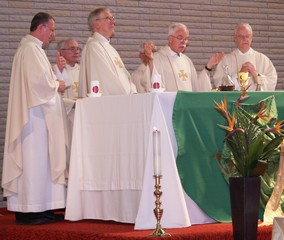
That being said, there are moments, such as ordinations, when it is appropriate to have many priests vesting and concelebrating, as a demonstration of solidarity with those being ordained. We need to be able to own our leadership roles as Jesuit priests. At the same time, if we are to emulate Ignatius and first companions, we are always humble priests in this least Society. "Ignatius wanted [Jesuit priests] to ask for the grace to be truly poor in companionship with Christ, to be obedient in their mission, to be held in low esteem if God would be thus served, and to live as 'priests of Christ freely poor.'" (GC34, decree 6, 174)
My sacramental ordination gives me a specific but not exclusive role within the Church's participation in Christ's priestly mission. One particular moment in the Mass brings this into relief. Following the preparation of the gifts the presiding priest says to the assembly, "pray brothers and sisters that my sacrifice and yours may be acceptable to God the almighty Father" and those gathered respond, "may the Lord accept the sacrifice at your hands etc."
The celebration of the Mass is not a rote act where such responses are utilitarian and I like to think that the presider needs to attend to this response of approval so that he can continue the celebration. Those gathered are not an audience at a concert but an integral part of the Eucharistic action.
My life and mission as a Jesuit priest has a much broader scope than presiding at Mass. Still, participation in the Eucharist is one of the central elements of our day from which we go forth as a priestly Society, priests and brothers, to serve a priestly people in Ignatius' mission 'to help souls.'
No Comments