Not having one’s “papers” in order in France was seriously frowned on. Or at least, that was so years ago were one stopped by the police–not unusual if the individual was neither white nor “French-looking”–and immigration papers and visas were either lacking or out-of-date. The results could be chilling, to say the least. I have no idea what the situation in France is now, and no doubt the police have lightened up a bit. Yet certainly in 1970, they were very serious about such matters. Very serious indeed!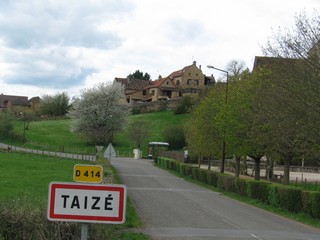
A young Dutch Jesuit whom I had known while in London in 1969 and 1970, invited me to join him in early November in the Jesuit house of theological studies at Fourvière, Lyon, in southern France. He had moved there in September 1970 to begin his theological studies towards the priesthood.
Not having taken a vacation the previous summer, I decided to travel there by train, a pleasant ride indeed, even in the pre-TGV days. As we passed through the lovely Burgundian region between Paris and Lyon, the landscape was stunningly beautiful, with kilometre after kilometre of vineyards spread out, golden in the autumnal sunshine.
After a few days in Fourvière, we–four young Jesuits–decided to drive to Taizé, well known for its liturgy, spirituality, its peaceful setting in a small village north-west of Macon, and for its attracting young people from all over the world. The four of us, my Dutch friend, an American, a Columbian, and myself, set off in a beat-up old Renault, hardly road-worthy, and very shaky, a real pile of junk. Only the American was willing to drive it.
Everything went well, even on l’Autoroute du Soleil where the police were ever vigilant about moving-piles of junk. We were not stopped, and reached Taizé well before noon. There we spent a lovely few hours, in silent prayer, attending the beautiful public prayer in the ecumenical church, and conversing with several young Brothers. The “youthful” atmosphere of the place, with young people everywhere, delighted us. We each agreed that seldom had we ever experienced such spiritual peace in any spot.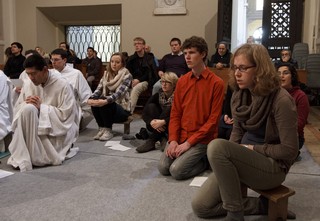
As time passed, we became anxious to return to Fourvière before sun-down since the car’s head-lights did not function. We headed out, but with the intention to return via Paray-le-Monial, a place well-known in Jesuit history. There Saint Claude de la Colombière had been the confessor of Sainte Marguerite-Marie Alacoque, a nun in the Visitation Convent. There, too, over the years Jesuits had spent their final year of formation in the Jesuit college, including a number of Canadian Jesuits. We wanted to visit briefly both places.
We stopped at the church of the Visitation nuns first. Partially hidden behind a screen in the front choir, some very elderly nuns were singing the divine-office in very high slightly off-key voices, while in the huge nave was a hand-full of very elderly women in black.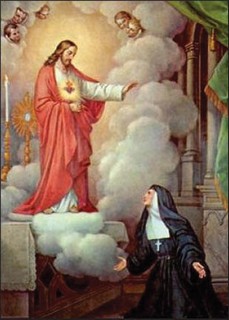
The obvious piety we could admire, yet it was not an especially inspiring moment. Undoubtedly we were unfairly comparing this place with Taizé, but after the youthful, rich spiritual experience there, after the glorious hymns, the whole atmosphere in this church seemed stifling and moribund. We quickly left.
On the way out of town we visited the Rector of the Jesuit college. When we spoke about our two very different experiences that day, he laughed gently. Clearly he understood why we were unwilling to remain in the church.
We headed onto l’Autoroute du Soleil, and shortly stopped at a toll-booth. The police were waiting on the other side examining cars. Ours attracted attention. We were hailed over to the side. As we sat waiting, the Dutch Jesuit said, “Act as if you don’t understand French, and say nothing.” Not very good advice in the end!
We all gave over passports while the three others also handed over their “papers”. In only seconds it seemed, we were ordered out of the car. The Columbian Jesuit’s papers were “Not in Order”.
Several policemen then surrounded us, asking questions. Whatever in his papers was not in order long since escapes me. Certainly, Columbians did not easily travel in those years, and perhaps he had difficulty renewing his visas. I can’t now recall. What I do recall, though, is the time being grilled.
Eventually three of us were ordered back to the car, while the Columbian was taken to a police car. More time was spent questioning him. We gave up on the idea of getting back before sun-down.
After a long time the Columbian Jesuit returned to the car, shaken, yet none the worse looking. The police let us go, perhaps forgetful about the car’s run-down condition. While he was uttering a few choice Spanish words about the French police, we entered again the very busy autoroute, this time with night falling but without head-lights.
Several drivers honked at us, others shouted about driving without lights. Yet on we went for some sixty kilometres until we reached Lyon, and made our way up the narrow darkened streets of Mount Fourvière to the Jesuit residence. We felt relieved to be back safely!