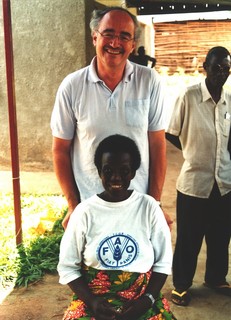
After eleven years as Secretary for the Social Apostolate at the Jesuit Curia in Rome, I worked on AIDS in Africa from 2002 to 2010 as the founding coordinator of the African Jesuit AIDS Network, based in Nairobi.
Its mission was to encourage, support and assist Jesuits and their co-workers throughout sub-Saharan Africa (basically, in the nearly 30 countries where Jesuits are present) to respond to the multiple challenges of HIV/AIDS in a coordinated and reflective manner, manifestly inspired by the Gospel and oriented by the teachings of the Catholic Church
In January 2012, invited to address a conference in South Africa, I was assigned this question: "Over the past 30 years since the discovery of HIV, how has the Catholic Church responded throughout the world?"
This is how my talk began:
My first encounter with AIDS was in 1988, at l’Arche in France. One day Catherine, an Assistant, told the founder, Jean Vanier, that her brother Serge had just died of AIDS. Serge was in his early 30s; he was homosexual, and most of his friends were viscerally anti-Catholic. But Noël, Serge’s partner, reported that he had asked for a funeral Mass. It fell to Catherine to arrange it. Her father, step-mother and two sisters were triply crushed – by the homosexuality, by the AIDS, by the early death of their only son and brother.
Catherine went to the parish close to the Père Lachaise Cemetery but the priest remained distant and showed no compassion – if Serge and his friends were not practicing Catholics, why bother with a funeral Mass? Catherine sensed that the man was afraid; he certainly had no sense that these people needed to hear words of hope spoken “inside the Church.”
So Catherine asked Vanier, who told her to ask me – I happened to be at L’Arche during Lent of ’88 on sabbatical. Later, she said that our first conversation reassured her. Both she and her late brother were being heard.
I met the whole family just after Easter, on the evening before the funeral. Catherine wasn’t sure they would come to the funeral; her father and one of the sisters had never gone to see Serge while he was ill and dying
A quarter-century later, remembering that evening and the Mass and the cremation the following day, Catherine refers over and over to an attitude. She says that I acted as a friend who listens; as a humble, calm and upright presence; as a little light in the midst of their sad and complicated family. This motley group of troubled family and friends found a gentle but firm guide. They even allowed me to lead them in prayer. Catherine recalls: “You did all this in an accommodating and respectful way … As for me, I saw that my brother had received the honour due to him for what he was deep down, a child of God. And this is what was most important.”
Catherine says I helped her and some of the others then. Now, I realize that I was helped to begin my own formation long before doing AIDS ministry in Africa. I learned that, for the Catholic Church, AIDS is so much more about the living than about death, more about healing than about sin – though we’re not afraid to call sin and death by their names.
So the attitude is all-important: to listen, encourage, console, befriend, support, soothe, touch and pray, pray, pray. What Serge, Catherine, the family and friends gave me was a starting point – this attitude, because Jesus is the friend of every child of God especially in time of need. 
The same year in which Serge brought AIDS into my life and priesthood, Victor brought it into the Society of Jesus. He was HIV-positive and entered the English Canadian Province in 1988 – that was before testing. Two years later he took vows and continued his Jesuit formation.
But then AIDS set in, for that was before anti-retroviral medication was developed. Subject to the usual opportunistic infections, he knew his days were numbered, yet he forged ahead upright in life. He died in 1994, at age 35, with his Jesuit brothers around him, having taught us that AIDS is a fact of life, no matter what your state of life.
My third teacher is Rosanna.
Rosanna, a single mother in her late twenties, lay abandoned because she was HIV-positive. Totally alone in a Nairobi slum and near death, fellow-parishioners knocked on her door and rescued her. Now 8 years later, she thanks God for them; she says, “My family has not accepted me, not my mother or sisters or ex-husband. I’ve lost jobs because I’m HIV-positive.”
Rosanna’s infant daughter died of AIDS. But her 12-year-old son Jomo, who was conceived before Rosanna got infected, is HIV-free. He is a bright, healthy boy who loves drawing and playing soccer. For him she tries to keep healthy: “I want to see my son grow up.”
This attractive woman need not lack for boyfriends. But once, after sleeping with someone without telling him her status, she felt so badly that she went after him to apologize and encouraged him to get tested. She thanks God for his negative test.
After that she effectively vowed abstinence. She tells young people her story, without rancour and with gratitude, and urges them to live well and to avoid the mistakes which lead to infection.
Rosanna fortified my faith in both the truth and the teachability of the Church’s teaching about sexuality – in the beautiful expression from the rite of ordination: teach what you believe, practice what you teach. None of this ought to change, even – especially – in the time of AIDS.
I wish everyone was like Rosanna but, of course, individuals are free to say “no thanks” and many do. We should not expect Catholic morality to reach and convince everyone and shape their behaviour.
This marks the Church’s difference from public authorities. The State has to reflect the mores of the population and make everyone behave lawfully. The Church’s moral position arises from a different starting point: not ‘what people generally think nowadays’ and ‘what present-day secular laws say’, but faith in Jesus Christ, His Gospel and other Biblical sources, and the development of Catholic teaching over the ages.
When you teach and promote Catholic morality, you can be made to feel unpopular, as Jesus was, but we pursue what we know to be right and loving and respectful of human dignity – and therefore healthy in its most profound and holistic sense.