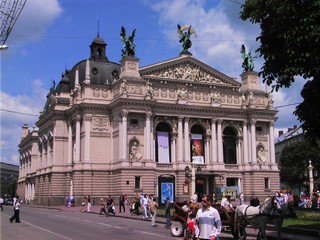
 Three things confront you in daily life in Ukraine, from conversations to projects to state government. First is the complicated drag of the Soviet legacy; second, the irreversible integration into the modern, globalized world; third, the deep quest for spirituality. So, let’s buy a house, open a centre for refugees, and give an eight-day retreat to see how these aspects play out.
When I came to Ukraine in 2002, my main task was to set up the normal structures of the Society of Jesus: where to live, what to do, and how to prepare our men. As we had about eight vocations, we needed a house that could accommodate up to ten people.
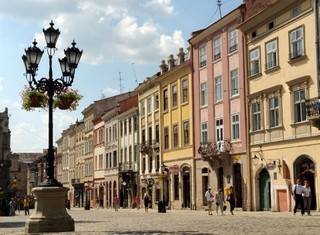
The absolute recommendation at the time was to avoid anything Soviet-built, which in Lviv meant all buildings built from 1945 until 1991. A quick glance showed why: concrete stairwells were crooked, the steps not level, hot water and heating would not always reach beyond the second floor, no insulation was ever used, and there was never any aesthetic value in the construction. It was better to build new or buy a building built before WWII in the period of Austrian rule. So, we bought an eighty-year-old house in central Lviv.
Lviv is a city judged by UNESCO to have unique architectural and historical qualities. This notwithstanding, any building project falls under a baffling array of permissions. One must keep in mind that Soviet bureaucracy was not set up to serve the needs of people but the nervous needs of the state. This legacy was most obvious when it came time to renovate.
Although we had the money in hand and an excellent firm ready to work, we had to have our plans officially approved before construction could begin. Whereas in Canada, there would normally be one building permit, in Ukraine there can be up to fifty.
For example, three permits were required for installing a new furnace and radiators. Successive permissions were required from three different government agencies, located in three buildings in three different parts of the city. Technical drawings had to be approved three times. Each approval meant standing in line for one to three days. One could be sent back to a former agency if a latter one saw something unfit in the documentation.
As often as not, the delay was a tactic to invite a “gift” (read, bribe) to speed things up. Once the technical plans were approved by all the agencies, we had to present the documents to the gas companies. There is one state company that sells the gas; another that transports it to the city limits, and a third that transports it from the city limits to your house. Once again, three buildings, three queues, and three hopes for gifts.
However, it was not as simple as that. Although the house had long been heated by gas, a change of owner requires the new owner to attend “the gas course”. The daily instruction lasted three months at two hours per day and failure to attend any one day meant having to start all over again. Without this course, the owner could not have his furnace connected. At the time, the course cost about $20. Of course, if you gave a gift, namely, the $20, directly to the official, you could have your graduation certificate the next day and the house heated the following day.
When you multiply these gas procedures by all the other facets of construction, such as, electricity, water, roofing, windows, doors, fire safety, and restrictions for historical buildings, the process for acquiring the permits can take up to a year (six months in our case), with a person working full time only on this.
It helped somewhat that we were a religious community: it was somewhat quicker and there was less demand for overt bribes. At the same time, the firm that did
the renovations, used very modern technology, which largely came from Germany. The firm was very actively learning new techniques and employing them to good effect and with great conscientiousness.
After a year of renovations, we were living in the house. Up to that period, such renovations might have taken 3-7 years to complete. Young firms are anxious to learn and produce quality in line with western countries.
Four years ago, when we opened a JRS Ukraine centre, all of these procedures had become easier. This project remains one of very few instances of church-state collaboration. Clearly, there had been no such thing during Soviet times. Equally clearly, the country was not used to receiving refugees since people were more inclined to seek a way out of rather than into the USSR. Now, refugee claimants from Iraq, Afghanistan, Iran, and Africa were seeking protection at least in Ukraine, if not in the neighbouring European Union.
Although the government did not know what a church organization could do, it was anxious for help and, once hearing about JRS’ reputation, sought our collaboration. Our centre receives up to 24 asylum seekers where they receive free room and board. Our lawyers represent them without charge and we teach them Ukrainian language and culture, register their children in schools, and bring them to clinics for medical needs.
When government officials visit our centre, they are struck by two things mainly. First, the centre is well run: it is cost effective, the asylum seekers collaborate in the house work, and they are happy. This contrasts with the government-run centres where there is corruption, depression, constant
theft and destruction of property. 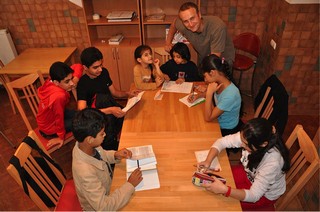
Second, as is the Ukrainian custom, we pray before meals. There are Christians, Muslims and non-believers among the residents and all receive these short prayers with deep respect.
The Director of Migration Services for the country and the regional head of Border Control were surprised and moved by the atmosphere. They asked for private conversations and confessed their difficulty in trying to be people of conscience in a government system known for corruption. Each asked to be prayed over and remembered in our prayers that they might have the strength to act more according to their conscience. In the end, the Migration Services asked whether we could take over all of their centres.
Now let’s make a retreat. We built a retreat house in central Ukraine. During the Soviet years, the underground church had been quite active. Although starved for theological education and social ministries, generation after generation were taught prayers, attended covert liturgies, and inherited a sense of fidelity to God. With the fall of the Soviet Union, people could now fill in what they had been lacking for 50 years.
One can see that in the culture there is a deep respect for things holy and a thirst for some connection with God. Even though people learned prayers from their grandmothers, they were without religious culture and basic catechesis.
Our retreat house is one of perhaps twenty newly built in the country. Its clientele is mostly lay. I give a retreat there each year to young professionals (25-35 year olds). Within the group will be Catholics, Orthodox, Protestants, and people completely unchurched. What amazes is the open thirst for
spirituality from all these backgrounds. 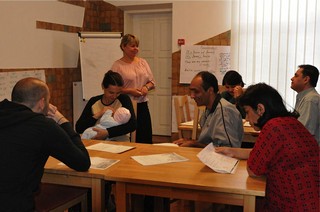
Knowing well the problems within the country, these people feel called to do something first within themselves in order to do something within the country. Like Dostoevsky, they judge that without a real connection with God, nothing will change for the better.
All of these people are or have become socially and politically active. Several have been baptized on the basis of these yearly retreats. One has become a parliamentarian. Several others work in the state administration. They have a sense that God calls them to this, despite the amount of work that needs to be done to bring social values into the political forum.
These experiences have led us to create seven cells of young adults who meet weekly to pray and discuss faith and social life. The battle of good and evil is being lived out daily in Ukrainian society and more and more people are making their choice. As the Byzantine liturgy says, “God has never stopped creating the world.”