 Jesuit pride is a dangerous sin with many consequences in our history. Perhaps the greatest consequence of that sin allowed the seemingly unthinkable to happen in the seventeenth century. We were suppressed by a papal brief issued by Pope Clement XIV on July 21, 1773. But that seems to have been a painful decision for a pope who was reluctant to put us out of existence. He was trapped into a corner and eventually forced to suppress the Jesuits.
Like many significant historical events, the suppression only came about because of years of back room politics and skirmishes. They have their start in the late 1750s, and, step-by-step, culminate in Clement’s decision. Fr. Robert Scully, S.J., a contemporary historian, sums up the events leading to Pope Clement’s decision. “As European kings consolidated their power in the eighteenth century, several of them saw the Church as an obstacle to their political objectives. Thus, with their stated allegiance to the Papacy, the Jesuits became perceived as enemies of the state in some quarters. The local confrontations gradually coalesced into a movement to suppress the Society of Jesus in its entirety.”
The general suppression of the Jesuits would never have happened if it were not for the national suppressions and expulsions of Jesuits from Portugal, France, Spain, and some Italian states (and their colonies around the world). This is all part of the long-running conflict of church and state, and the usual ecclesiological and political tensions. Clements’s predecessor as pope tried his best to keep the Jesuits in existence as leaders were gradually suppressing us. But the pressure on him for a general suppression was increasing, so much so that he suffered a heart attack and died.
The conclave to elect his successor was of great interest to all who were watching the unfolding of this saga. The “interest” was so great that there was influence from some Catholic monarchs in Europe. Early in his papacy, Pope Clement XIV was giving mixed messages about where he stood with respect to the Jesuits. But, after several years in the papacy, his procrastination collided with the mounting pressure from others.
Much of our knowledge of these events comes from the observations of Fr. Giulio Cesare Cordara, who had been a Jesuit for fifty-five years leading up to the suppression. He writes of the “hidden sore spot for the Society” which lead to our near-extinction. “My former Jesuit companions will have to admit along with me that there was much pride among us.” He says this of those who formed us: “Once they had imbued our minds with such a high esteem for the Society, in vain were they trying to instil humility and deference.”
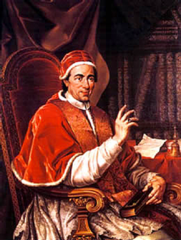 The great Jesuit historian, Fr. William Bangert, says that Pope Clement’s document “suppressed the Society but without condemning it.” And, in assessing the Church, writer Eamon Duffy says that the suppression of the Jesuits “was the papacy’s most shameful hour.”
I offer two interesting footnotes to this story. First, there were exceptions to the universal suppression of the Jesuits. Frederick the Great of Prussia refused to be dictated to by Rome. Catherine the Great of Russia saw that the Jesuits could provide great opportunities for education.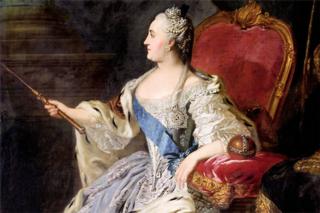
Secondly, when Pope Francis was elected in 2013 and was explaining his selection of his chosen name, he joked that he considered taking the name Clement, as a way of getting back at the pope who suppressed us in 1773. Of course, the Jesuits still exist. That’s referred to as the Restoration of the Society and it came about almost forty years later. We’ll tell that tale another day.
++++++++++++++++++++++++++++++++++++++++++++++++++++
This posting is greatly indebted to Robert Scully, S.J. for The Suppression of the Society of Jesus: A Perfect Storm in the Age of the Enlightenment. This article can be found in the Summer 2013 issue of Studies in the Spirituality of Jesuits.