For many years I nurtured two travel destination wishes: Tibet, and Upper Mustang in Nepal. Our golden jubilee as Jesuits in 2010 was an excuse for Roger Yaworski, Winston Rye, and I to visit Mike Parent in Tibet. This year, 2013, was the sixtieth birthday of our mobile clinic benefactor, Christopher Fussner and I gladly accepted his invitation to visit Mustang.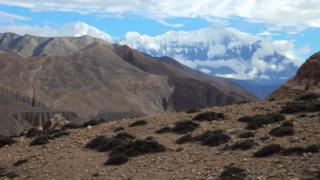
August 12, our party of six flew out of Pokhara to Jomsom, early enough to avoid gathering clouds and the high winds which daily surge north up the Ganadaki River Valley. I have some faith in Twin Otters and experienced Nepali pilots, but flying through cloud in Himalayan regions, and then swooping down to the river at Jomsom, afforded twenty minutes of serious prayer.
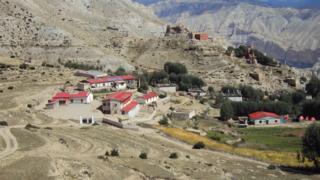 In the dry season, one can bounce in a jeep north along the Gandaki River bed most of the way to Upper Mustang, but monsoon floods kept us higher, on trails and rough tracks. Riding horses and pack mules awaited us at Jomsom, and after a quick lunch we were off for the first half day of walking to Kagbeni, a popular tourist halt. As on every day’s arrival at camp, we found tents set up and refreshments ready.
August 13 saw us continuing north traversing steep slopes, watching a herd of blue sheep, and marveling at the green, gold and red fields marking water sources. Rain is slight here, thanks to the Himalaya, now to the south of us, which block the monsoon clouds. Villages are small and scattered, with houses made of mud and stone, with flat roofs. By now I had given up on the horse, a gentle animal but with a mind of its own. Late in the day we crossed the Gandaki on a walking bridge and climbed to Tsele to enjoy our second camp. The morning brought us a steep climb, then drop to a stream, then up again, and again, to Chunkar, a tiny village marked with an orchard of ripening apples and a stand of poplars, the most common tree in this dry land. A huge chorten graced the village. 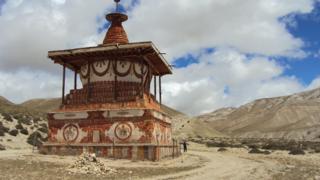
The Feast of the Assumption offered us a change of pace. We drove to Lo Mantang, the capital of the area, in two jeeps. We saved time but put up with a lot of bouncing, and one change of vehicle thanks to a bridge closed for repairs. Lo Mantang is a walled town, at an altitude of about 3,800 meters. The king lost his political power in 2008, when Nepal became a republic, but the people offer his family great respect. His nephew, Jigme, is now Crown Prince, and Jigme’s younger son a Rinpoche (reincarnation) at the local Shakya (one of the four Tibetan Buddhist sects) monastery. Chris helps fund the local medical clinic at the monastery school, so our first visit was there. The following day we visited the town’s two Gonpas, where the monks chant their daily prayers. Over the last decade UNESCO has funded the restoration of these sanctuaries, both in sad condition thanks to an earthquake or two, and rain. Artists are daily busy restoring murals and painting parts too damaged to restore.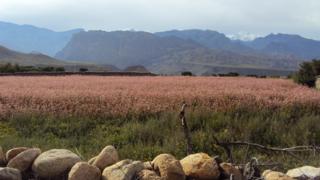
The monks spent the next few days at prayer, mainly to consecrate one of the restored prayer halls, dedicated to Mahakala, a fierce form of Avalokitesvara, actually a benevolent spirit. The prayers went on and on, accompanied with various horns, conch shells, and cymbals. Meditation is easy, while the rhythmic chanting calms one, and the crashing of instruments prevents dozing. Suddenly all prayer stops. Each monk produces a blessing scarf. A monk moves Chris to a chair in the middle of the assembly. Each monk, from the youngest of the novices to the Abbot, and even the Rinpoche, offers a blessing scarf to Chris. Then out comes the cake (thanks to our camp cook, a great baker). The monks sing Happy Birthday in English and Tibetan. Then when Chris has cut the cake all the monks and visitors get a piece.
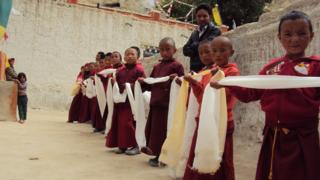 The party over, the monks go back to their next round of mesmerizing chant and music. Have you ever been to a formal church blessing? Can you picture a pause in the liturgy to celebrate a birthday? We have something to learn here! I continue my own daily prayers, offering Mass in my tent, sometimes with Chris, the only Catholic in the group. One night I neglect to properly close my tent and sleep soundly through a heavy rain. I awake to find my breviary in a puddle. It will be nice and dry again after a few months. Meanwhile I turn the pages carefully.
We spend a day heading north from Lo Mantang to visit Chosar, as far as tourists can go. The Tibet border is getting close, close enough that the shops provide Chinese beer and Red Bull energy drink. The monks enjoy the soft drink during prayer breaks! Many Chinese motorcycles cruise the hills, none with Nepalese registration. There is no motor vehicle office here. There are two attractions at Chosar: a little boarding school for youngsters who will hopefully become monks and nuns, to care for the local Gonpa; and caves.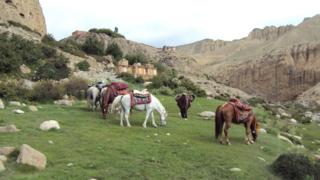
All along the cliffs here one finds old caves which seem to have served as homes in the past, and as meditation cells. This old and lucrative trade route has seen its share of local wars and robberies, so the caves would have provided refuge to villagers. We enjoy the day climbing through a few of the caves.
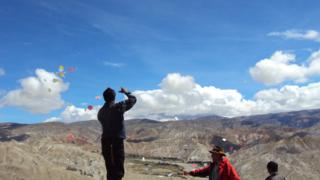 A day hike takes us up to a ruined dzong (fort and monastery) overlooking Lo Mantang. We enjoy scattering little papers printed with prayers, and watching them soar upwards with the wind. We drop past the ruins of a monastery to the village of Namgyel. The monastery there is being rebuilt so we can’t visit, but marvel at the vegetables ripening in a green house, and enjoy wandering back through wheat and barley fields. Another walk takes us up a side valley, past herds of sheep and yak, to a set of chorten marking and old temple and a line of meditation caves cut into the rock. I will never again complain about Spartan retreat houses.
Our trip down the valley allows for two nights at Ghiling, where we visit an attractive private school and health post. We continue south past Jomsom to Marpha, the center of the valley’s successful apple orchards. Our camp is at Chhairo, another restored gonpa next to a Tibetan refugee camp. A final pretty hike back to Jomsom ends our holiday. The only challenge, now, is to get a flight back to Pokhara. Weather does not cooperate so I take buses south on the “highway.” A long day of jolting with several bus changes because of road blocks, gets me to Pokhara. And a good rest at our lodge. 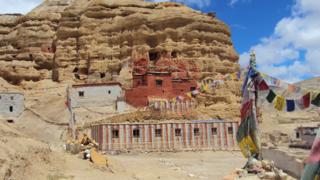
Back at home I enjoy comparing Kathmandu, Upper Mustang, and Tibet. Tibet is certainly the most organized and developed, but lacks Nepal’s happy-go-lucky enjoyment of freedom. Kathmandu is rich and convenient enough but getting chaotic. Mustang is developing, with electricity, wireless communication, and roads of sorts. The people there deserve these conveniences and the help they are receiving to save their cultural and religious heritage. I hope they can continue to enjoy sharing these gifts with one another and those lucky enough to visit them.
********************************************************************
Photo Captions: (All photos courtesy of Bill Robins, SJ and Chris Klep)
Photo 1 = Looking south at the Himalaya.
Phot 2 = Looking down at Ghiling School, wih our camp in the right in part of the school grounds.
Photo 3 = Chorten.
Photo 4 = Flowering buckwheat at the end of Ghiling Village looking east.
Photo 5 = Welcome party at Chosar.
Photo 6 = Horses resting.
Photo 7 = Prayers rise in the wind!
Photo 8 = Chosar monastery and caves.