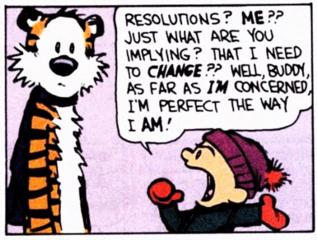
 New Year’s resolutions are the worst way to begin the New Year. Resolutions often breed failure and if they do not then they add on one’s shoulders the burden of keeping these resolutions. Whare resolutions so necessary or appropriate to the New Year? Why does resolution tend to accompany new starts? Is there even such a thing as a new start? Is it the same old all over again? It seems to me that resolutions put one on a vicious cycle of failure. The reason I want a new start in the first place is because I had originally resolved to turn over a new leaf. What is the etymology of the word resolve? The word is comprised of two latin words: re (again) and solvere (loosen). In the Victorian Age it was considered very macho to resolve oneself to do something. There are still residues of this macho sense of the term today. Originally, however, the word meant to loosen up or to unburden one’s yoke.

Yet in my experience resolutions tend to have quite the opposite effect. People tend to yoke themselves with resolves and promises. What are we thinking when we resolve to do something? Resolution is accompanied by the sense of wanting to start over. So we say to ourselves, ‘it is going to be different this time. I am not going to fail or give up like last year.’ This sort of gearing oneself up is rooted in the realization that I was a failure last year. Not the best way to start the New Year is it? Perhaps a better way to start the year would be by acknowledging that I am an absolute success and my life could not have been more successful. I have been successful at being a failure.
Another irony of resolutions is that we tighten ourselves up to loosen ourselves up. W tighten our bodies and minds up by being resolved (or loosened up) to not being a failure this year. But resolutions have nothing to do with being successes or failures. Resolutions are about letting go and about loosening oneself up. Loosening oneself up for what you ask? ‘Absolutely nothing!’ I answer. It is simply about loosening oneself up.
 The most exemplary resolution is in Jesus’ voice as he says regarding the resurrected Lazarus: “unloosen his bonds!” Lofty ideals – this is not what New Year’s is about. Lofty ideals – these are the trappings of death. They are meant to die with the old year. The New Year is about letting go of our ideals and actually living life. How good it must have felt to Lazarus after being buried in that congested and stifling tomb and after being mummified in his bandages to breathe the fresh air and to feel the warm sun on his face. This is what New Year’s is about: breathing fresh air again and feeling the sun on one’s face again (even if New Year’s happens to be in the dead of winter) and rejoicing in life.
Yes, you are right! Writing about it in this way makes it sound ideal. Which is why there is no point in writing or talking about it. It has to be done and felt and lived. The only way of living it is by giving up our ideals and by loosening ourselves from them. “Get busy living or get busy dying.” These are Andy Dufresne’s words to Red in the movie The Shawshank Redemption. Let this be our only resolution every New Year: get busy living or get busy dying.
In the movie Andy plans to escape to a Mexican city called Zihuatanejo (pronounced: zoo-ata-neho). Andy says that it is a place without memory. A place of forgetting. New Year’s resolutions are all about escaping to Zihuatanejo. Let us forget our lofty ideals and lofty goals for they are the trappings of the dead. We are the resurrected people. The people of forgetfulness. We are the people busy with the business of living. Let us start this New Years by living and forgetting and letting go and moving on. This New Year’s let us all march to Zihuatanejo!