All holidays bring family and friends together, and Christmas does so in a particularly strong way. The tradition of exchanging of gifts has much to do with it, but there is something additionally community-oriented about Christmas because it is about the birth of a child. The arrival of a baby into the world has brought people together at all times and in all cultures; how much more so does the birth of the Christ who is born as a brother to all.
 Perhaps it is because of this aspect of the holiday that I have been thinking of a recent community event I attended in the light of the Christmas mysteries. The old art-deco Hollywood Theatre in the Kitsilano neighbourhood of Vancouver that is slated to be torn down to make room for development was showing what was being billed as its last film—a tentative designation, since the volunteers who organised the screening dearly hoped that through their petition and hard work the development could be stopped and the theatre restored.
The film was Frank Capra’s 1946 screwball comedy You Can’t Take it With You [www.imdb.com/title/tt0030993], in an original, 35 mm print complete with animated short before the main feature. Unlike the director’s other masterpiece, It’s a Wonderful Life [http://www.imdb.com/title/tt0038650/], whose climax and resolution take place on Christmas Eve, the film we saw at the Hollywood is not ostensibly a “Christmas film”. But its themes of family, friendship and spiritual freedom are similar in many ways. Clearly, these themes inspired the event’s organisers, particularly in that the film’s plot involves a struggle between ordinary folk and big business interests.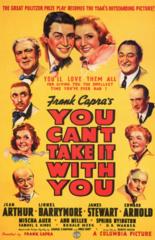
The story of You Can’t Take it With You centres around “Grandpa” Vanderhof and his somewhat eccentric family who refuse to sell their New York home to a big developer who has bought up the rest of the block but needs this one last property to proceed. Meanwhile, Grandpa’s granddaughter, Alice, becomes engaged to Tony Kirby, who is none other than the son of the tycoon who is trying to take over the city block. However, because of the large number of middle-men working on the deal, neither Tony nor his parents is aware that it is precisely the Vanderhofs that are holding up Mr. Kirby’s business coup, a situation from which much of the comic impetus of the film springs.
The story not only has a strong message of the importance of family and community, but also of one of conversion. Both Tony Kirby and his parents are slowly made aware that their disordered attachments to business, success and honour are destroying their own happiness and blinding them to their responsibilities as human beings.
 Significantly, this growing awareness is made possible because of an experience of community. It is through contact through the joyful and tight-knit Vanderhof family that the Kirbys realise that there is more to life than worldly success. The Vanderhofs are a compelling example of what the Second Vatican Council document, Gaudium et Spes [http://www.vatican.va/archive/hist_councils/ii_vatican_council/documents/vat-ii_cons_19651207_gaudium-et-spes_en.html ]meant when it taught, “The family is a kind of school of deeper humanity.” As Gaudium et Spes continues to explain, this school springs from a “kindly communion of minds”: precisely the kind of communion that exists among the Vanderhofs, as quirky as they might be.
The Vanderhof’s familial communion is not only capable of calling others to conversion but also to spiritual freedom. For another of the story’s core messages is the importance of living life joyfully. The Vanderhofs do as they please, in the best possible sense. They are generous and hard-working, but they choose how they work and how they are generous in such a way that it be life-giving. They seek to find the joy in the moment, and the rest they leave up to God, as Grandpa Vanderhof expresses in his grace before meals:
Well, Sir, here we are again. We want to say thanks once more for everything you’ve done for us. Things seem to be going along fine. . . . We’ve all got our health and as far as anything else is concerned we’ll leave it to you. Thank you.
 As I reflect on all these themes, coupled with the atmosphere of the audience at the Hollywood Theatre who followed the film intently, joyfully and communally, a verse from an old Christmas carol runs through my head:
Good Christian men, rejoice,With heart and soul and voice.Now ye hear of endless bliss,Jesus Christ was born for this.?He hath ope'd the heav'nly door And man is blessed evermore.Christ was born for this,Christ was born for this.
Community as a school of human living; human living as a joyful generosity. Indeed, “Christ was born for this.”