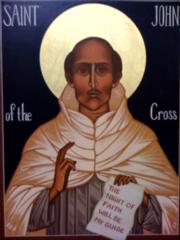
 On December 14, the Church celebrates St. John of the Cross, one of the greatest mystics in the history of Christianity. He lived in the sixteenth century and received part of his education from the Jesuits. He and St. Teresa of Avila founded the Discalced Carmelites. His search for the most austere and rigorous form of Carmelite life meant that he often had difficulty with superiors, so much so that he was imprisoned in a narrow, stifling cell for more than nine months. Despite his sufferings, he received tremendous consolations. Some of his poetry comes from that period.
Most of his life he experienced the very grace he prayed for: “to suffer and to be despised.” Toward the end of his life, even his adversaries acknowledged his sanctity. John is the author of several spiritual works, the most famous being The Ascent of Mount Carmel and The Dark Night of the Soul. The basic idea behind his mysticism is that the soul must empty itself of self in order to be filled with God, that it must be purified of the last traces of earthliness before it is fit to become united with God. The “Dark Night” is a period of heavy trials where God perfects the soul.
Very few of us are called to that form of mysticism. Most of us do not even have a slight inclination to it. The difficulty with John and Teresa is that we get the impression that Christian mysticism is something extraordinary, reserved for just a select few. Much more palatable is the form of mysticism that we see in people such as St. Ignatius of Loyola and Thomas Merton. Merton said that all Christians are called to a similar realization: “the awakening to a new awareness of ourselves in Christ, created in Him, redeemed in Him, to be transformed and glorified in and with Him.” It’s what St. Paul describes as being rooted and founded in Christ.
Karl Rahner, an influential twentieth century theologian, describes an “everyday mysticism.” He writes of ordinary Christians who are faithful to prayer, even when there seems to be no response from God and concludes, “There is God and his liberating grace. There is the mysticism of everyday life, the discovery of God in all things; there is the sober intoxication of the Spirit.” It is an awareness of God’s presence, being fully convinced that Christ lives within us.
Rahner, of course, was a Jesuit. As such, he was imbued with Ignatian spirituality and its rootedness in the search for God in all things. We cannot be selective and decide that we will just find God in the beautiful, in the healthy, and in the sunny skies. Ignatius challenges us to discover God in the ambivalent, in the mediocre, in the destruction, in illness, in struggles, and in stormy skies. That ability is what makes us mystics of the everyday.
 Since the middle of the twentieth century, the image of Ignatius as a mystic has grown stronger. People look to his experiences in the cave at Manresa and in an experience outside Rome where he had a profound sense that God was with him. But, apart from special moments, Ignatius was always aware of the intimacy of God’s nearness and help in all circumstances, no matter how mundane. Ignatius saw that any of us can have that immediacy to God. This is mysticism. And, as our world and our culture become filled with more and more distractions, we can all be helped by that sense of God’s nearness.