The Huron Carol is attributed to the Jesuit missionary and martyr, Jean de Brébeuf, and was first heard at Sainte-Marie Among the Hurons in 1643. Brébeuf based the melody on a French folk song and wrote the words in Huron/Wendat. The original title is “Jesus Ahatonnia” and is translated as “Jesus, he is born.”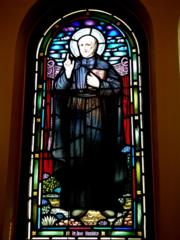
Those early Jesuit missionaries documented their experiences in reports later published as “The Jesuit Relations.” These documents contain the observations made by European-trained Jesuits during their missionary campaigns here. They record their experiences of culture shock and the sometimes deadly dangers they faced, daily. Here is a brief sampling of how some of Brébeuf’s fellow Jesuits interpreted the music they heard as they encountered Canada’s First Nations:
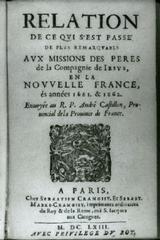 … They accompany their songs with drums. I asked the origin of this drum, and the old man told me that perhaps someone had dreamed that it was a good thing to have, and thus it had come into use. … As to this drum, it is the size of a tambourine, and is composed of a circle three or four finger-lengths in diameter, and of two skins stretched tightly over it on both sides; they put inside some little pebbles or stones, in order to make more noise; the diameter of the largest drums is of the size of two palms or thereabout; they call it chichigouan, and the verb nipagahiman means, ‘I make this drum sound.’ They do not strike it, as do our Europeans; but they turn and shake it, to make the stones rattle inside; they strike it upon the ground, sometimes its edge and sometimes its face, while the sorcerer plays a thousand apish tricks with this instrument… .
Occasionally this man would enter as if in a fury, singing, crying and howling, making his drum rattle with all his might… he lowered his head and blew upon his drum, then blew toward the fire; he hissed like a serpent, drew his drum under his chin, shaking and turning it about; he struck the ground with it with all his might, then turned it upon his stomach; he closed his mouth with the back of one hand, and then with the other; you would have said that he wanted to break the drum to pieces, he struck it so hard upon the ground; he shook it, he turned it from one side to the other, and, running around the fire several times, he went out of the cabin, continuing to howl and bellow; he struck a thousand attitudes, and all this was done to cure himself. (1634)
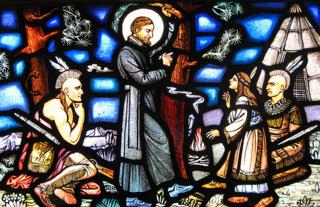
Three years later and the music-making is more collaobrative:
It is a sweet consolation to hear them sing publicly, in our Chapel, the Apostles’ Creed in their own language. Now, as a greater incentive to them, our French sing a strophe of it in our language, then the Seminarists another in Huron, and then all together sing a third, each using his own language, in excellent harmony. They like this so well that they make this holy and sacred song resound everywhere … although they used three languages, they harmonized so nicely that it was a great pleasure to hear them.
In 1676:
We celebrated the festival of Christmas with much devotion. We made a small crib beside our altar, to which our Christians came at midnight; and during the day they made the forest resound with their Hymns in honor of the new-born Jesus. What joy it was for us, both during midnight mass and during the morning mass, to see The Child Jesus acknowledged and adored by the [people] of this country, where the demon had so long reigned.
And then, in 1993:
Bruce Cockburn recorded an album entitled Christmas which includes his version of “The Huron Carol” – Jesus Ahatonnia – Jesus, he is born. In the liner notes Cockburn explains: 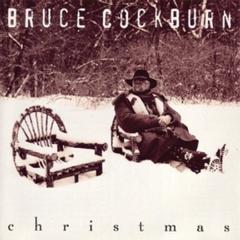
Otherwise known as 'The Huron Carol', this is the first Canadian Christmas hymn. It was written early in the 1600s by the Jesuit Fr. Jean de Brébeuf, who acquired fame and martyrdom soon after when he was ceremonially barbecued by members of the Iroquois confederacy, who went on to virtually obliterate the Hurons and their culture. They were encouraged in this by British colonial interests who were after control of French claimed territory, much of which was traditionally Huron. Those of this latter tribe who survived the wars were mostly absorbed into Iroquois communities. A few, however, stayed with the French colonies. Their descendants inhabit a couple of villages in modern Quebec, but their language has largely been lost.
Below is an audio link to Bruce Cockburn’s 1993 recording of Jesus Ahatonnia – Jesus, He is born at the True North Record site, Cockburn’s recording label since 1970. Listen to the way Cockburn blends this traditional, folky European melody with slightly altered rhythms and harmonies that suggest a different sonic world altogether. He takes it some distance from the reassuring Christmas-card world of “Twas in the Moon of Wintertime.”
http://www.truenorthrecords.com/Albums.php?album_id=38
Then, click on track 11: Iesus Ahatonnia