As many of you may know, Seamus Heaney, the greatest Irish poet since W.B. Yeats, passed away in Dublin Friday morning, August 30, at the age of 74. His funeral mass took place in Dublin, September 2nd. Later that day he was buried in his native County Derry, beside his brother Christopher, whose memory he immortalized in one of his most beloved poems, Midterm Break.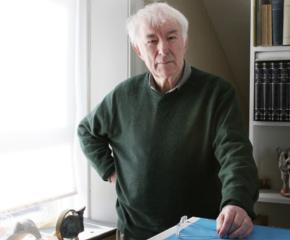
Like the arrival of news of any death, Seamus’s death was greeted with shock and then, of course, profound sadness. The sense of sadness is not just particular to Ireland, however. Indeed, our own Globe and Mail and The Toronto Star both have extensive articles on the death of Seamus Heaney.
The Irish Times offered the following reflection on Heaney: “Great poets speak for themselves but they also create the voices through which something beyond themselves finds articulation. What Heaney articulated, above all, was the way in which – in the words of his friend Brian Friel – confusion need not be an ignoble condition. Heaney told us that, though we are indeed fated to uncertainty, it need not necessarily be a locked room in which we play out the same scenarios of doom over and over. Uncertainty may simply be the human condition. Heaney humanized uncertainty, made ambiguity rich with possibilities. As he put it in the beautifully homely metaphor of Terminus:
‘Two buckets were easier carried than one. I grew up in between.’”
How might the parable on humility in Luke’s gospel that we heard on Sunday, September 1st, speak to the life of a poet, whose work is surely now part of the great canon of English Literature? By those who knew him, Heaney was described as a most humble and, actually, self-effacing character. He remained always a gentleman of the land, of rural Ireland—the “ground” which remained always remained the keeper of his memory and the soil which birthed rethinking of who and what we are and a subsequent transformation in how we respond to each other.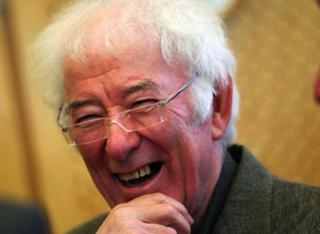
His poems too, in their consideration of the positive possibilities of uncertainty, are styled with a generative humility. But perhaps Heaney’s insistence and commitment to the work of the interior life is something we recognize and know to be both a work of humility and a work of urgency. In his poems, he closes the chasm that is often understood to separate the real world from the world of the imagination, or the spiritual world.
As Christians, we recognize what Heaney is illuminating in his poetry, that indeed the real world and the spiritual not only exist, but, more importantly, they are dynamically interrelated within one another—denying any desire of convenience to regulate one as nothing but “other” or “not of my world.” Our very prayers and commitment to justice bridges these two worlds into a comprehensive togetherness.
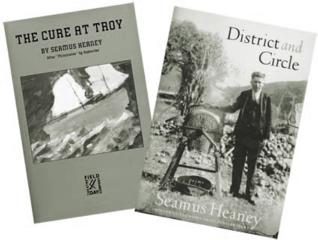 Heaney’s poems not only gives us hope, they also radically change our sense of solidarity. To be part of the “human chain,” to quote the title of Heaney’s later collection of poems, is not about a particular human chain of connectivity with those we simply agree with and love. No, this chain, of which we are all part of, is styled on the banquet invitation of Luke gospel: “But when you give a banquet, invite the poor, the crippled, the lame, and the blind.”
Reaching out to befriend those strangers who surprisingly enter our lives is captured beautifully in the final stanzas of Heaney’s poem, Lightenings.
The annals say: when the monks of Clonmacnoise
Were all at prayers inside the oratory
A ship appeared above them in the air.
The anchor dragged along behind so deep
It hooked itself into the altar rails
And then, as the big hull rocked to a standstill,
A crewman shinned and grappled down the rope
And struggled to release it. But in vain.
‘This man can’t bear our life here and will drown.
The abbot said, ‘unless we help him.’ So
They did, the freed ship sailed, and the man climbed back
Out of the marvelous as he had known it.
The ship comes along, it’s in the air, the community looks up and sees the ship, the crew man that comes down negotiates with the abbot and the community. After their meeting the “stranger” returns to his ship and sails off. He immerses in the visionary, in the other. He is welcomed by the abbot and helped by the abbot, to go free and to return to his world. The outsider and the abbot were negotiators, albeit most humble ones.
Heaney points to the realness of a negotiation, between strangers, between worlds, between those even of contradictory and different consciousness of reality. And isn’t that the very invitation of The Gospel of Luke, to have tables of negotiation, of meeting, of hospitality that are crowded with difference in ethnicity, in religion, in social status, and so on and more! Already we can see here that solidarity is about affirming those who have been denied a voice—excluded from the banquet table.
The humility, and subsequent hope, of Luke and Heaney seems a far distant hope in our time. We are surrounded by voices and cries of our human chain being ripped violently apart: poverty in our city and country, youth unemployment, the forgotten elderly, a mother in our city accused of the attempted murder of her 11 year old son, Syria, and we could continue…
And, on this day, we turn to and take comfort in the words of Seamus Heaney, and, as one columnist put it, “the extraordinary way he bore himself, the dignity and decency and the mellow delight that shone from him, he gave us self-respect.”
These words of Heaney speak to the very justice affirmed by Luke:
History says, Don't hope
On this side of the grave,
But then, once in a lifetime
The longed-for tidal wave
Of justice can rise up
And hope and history rhyme.
The Cure at Troy,
The words of Seamus Heaney,
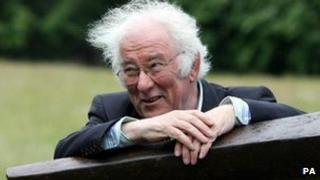
to quote his friend Paul Muldoon, gathered all of us up in his arms. His words reimagined places of safety and grounds of assurance in times fraught with violence and economic insecurity. His person taught us something about being human. When asked in an interview a couple of years ago, what words would best serve as an epitaph for his gravestone, Heaney initially resisted a response. However, his routine generosity with words moved him to offer these simply words which capture that which we always recognized to be most true in him:
“Where ever that man went he went gratefully.”