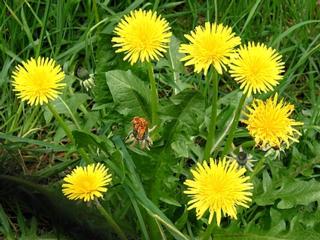
 I came across Taxacerum offinciale for the first time the other day. You may know it as "piss-the-bed." At least that's what we called them in Newfoundland. Our Francophone neighbours on the islands of St. Pierre et Miquelon used the French colloquial "pissenlit." The term "dandelion" is probably most familiar. Dandelion is a corruption of the French "dent de lion," referring to the angular, tooth-shaped leaves growing as a basal whorl at the base of the flowering stem.
As youngsters we picked the dandelion leaves for our parents who would prepare a delicious meals of cooked "greens" with dinner. Many an entrepreneurial kid would be found hawking bags of "greens" plucked from the roadsides and alleyways. Dandelion wine was left to the more adventuresome. During a Wilderness Survival course taken during my philosophy studies (I know, it does sound strange), we used the flower heads in a pancake breakfast after a night shivering in our hand-made shelters of sticks and stones. High protein value proclaimed our instructor. Definitely overrated.
You may think that the flower head is but one single flower. You would , of course, be mistaken. That brig ht yellow head is actually made of many small flowers called florets. The dandelion is in the family of flowering plants called Astereraceae (star-like) or Compositae. Compositae describes well the many-flowered composite characteristic of the dandelion and the more than 22,500 species in the aster, daisy or sunflower family.
There are two types of florets: disc florets and ray florets. The inner portion of the flower head or capitulum is comprised of florets with tubular corollas; these are the disc florets, and they represent the "centre" of the flower. The outer, more showy portion of the capitulum is comprised of florets with a single strap-like petal; these are the ray florets, and they represent the "petals" of the flower. The composition of Compositae capitula can range from all ray flowers, as in the case of dandelions, to all disc flowers, as in the case of thistles.
I used to love squeezing out the milky white latex from the dandelion stem. During the Second World War, the Russian dandelion (Taraxacum koksaghyz), a Slavic cousin of our dandelion, was used as a source of rubber. The roots of the Russian dandelion contain large amounts of the juicy latex. Interest in such dandelion-based rubber has grown in the light of a fungus that is threatening the rubber trees of Southeast Asia.
At the end of their flowering, the dandelion forms, as you know, those delicate spherical globes of seeds or achenes attached to their own little parachute. An ingenious way to spread the genes. Let the wind whisper and off they go in all directions. How I loved to aid such seed dispersal with the slightest of breath, just like the breath of the Holy Spirit, the giver of life.
The common dan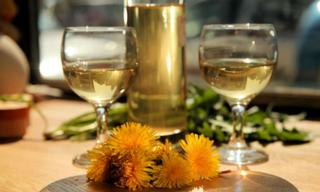 delion has become just that – common. Founded in Eurasia, Taxacerum offinciale has spread to all the world. Some consider it a weed. For others, it's an evolutionary success story as it disperses and establishes itself with facility and ease
We often take little interest in common things – like dandelions, starlings and crows. Familiarity breed contempt, so we say. Even the Latin epithet "vulgaris", often used for such common species, betrays our mild contempt for the "vulgar," or an least a recognition of their commonness. Think of the lowly beet (Beta vulgaris), the lilac tree (Syringa vulgaris) or the starling (Sturnus vulgaris), that most ubiquitous of city birds.
For some reason, however, I have always been attracted by dandelions. Maybe yellow is my colour. Maybe I like the fact that you're always sure to find a dandelion or two in flower except during the dead of winter. And the fact that they grow in so-called "wasteplaces" helps to brighten what could otherwise be a drab sort of place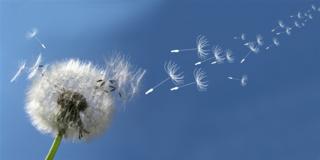
So, the next time you decide to engage in mechanical or chemical warfare on those dandelions, why not give them a second look. The fact that they're so "weedy" means that they have evolved some remarkable life skills. Take a look at their flowers – quite fascinating actually. And think of those bright, breezy days when the air is alive with the fecundity of dandelion parachutes.
If that does not enkindle attraction in your heart, you can always boil them up for a good feed of greens. Local, organic – and nutritious, what more could you ask for.